

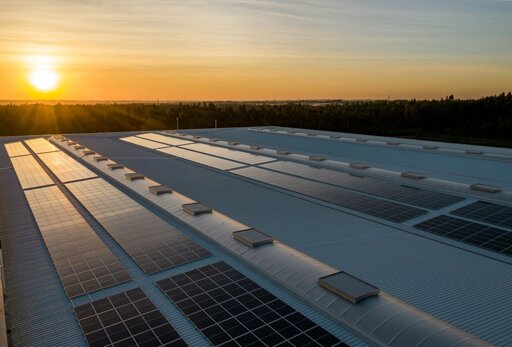
Imagine a world where solar panels continue to harness energy even when the sun isn’t shining. It sounds like science fiction, but advancements in technology are making this a reality. The idea of solar panels that work at night is not just an intriguing concept; it is a groundbreaking innovation poised to revolutionize the renewable energy landscape. This development could potentially bridge the gap in renewable energy production, offering a continuous source of clean power. As we explore this exciting innovation, we delve into the mechanisms, potential applications, and impact on our future energy needs.
Nocturnal solar panels might sound like a paradox, but they are based on a simple yet innovative principle. These panels utilize the concept of radiative cooling, where they emit infrared radiation to the cold night sky, creating a temperature difference. This temperature gradient can then generate electricity through thermoelectric generators. The idea is to harness the thermal energy that naturally occurs when objects release heat, allowing solar panels to produce electricity even in the absence of sunlight. This ingenious approach not only extends the functionality of solar panels but also opens new avenues for energy production.
Bullshit article based on absolutely nothing. Not even a single theoretical paper is mentioned in the article much less lab or a real world device.
“Maybe it could be done with thermo electric cooling” isn’t legitimate news. It’s a speculative opinion.
Pretty sure it’s AI generated but Stanford has been working on it. As of 2022 their panels could generate 50 milliwatts per square meter at night. Definitely far cry from the 200 watts per square meter during the day but I also don’t know how much power is used at night vs the day (guessing not that little).
The team has said they have ideas to greatly increase output but again no idea how much.
4000:1 is pretty bad. Also, you presumably only get that on a clear night.
Depending on the climate peak load often occurs just after sunset as people get home, take showers, and cook dinner.
Minimum overnight load is maybe a tenth to a third of daytime loads depending on which way the incentives operate.
If it’s only 50mW it seems like it wouldn’t be worth whatever the extra cost is to roll this out for anything except super niche applications. Even off grid you’re probably just better off saving solar in a battery or putting up a small windmill.
Yes 50 milliwatts is what googling says you can get from tegs. And the delta T giving 50 milliwatts drops to 0 in an hour after the panel cools to ambient at night.
That’s why the article is such bullshit. A basic understanding of heat can prove there’s not significant energy that can be harvested from a slab of glass going from 30C to 0C even at 100% efficiency.
Without even doing the math I’m screaming, “How long do they think solar panels take to cool down?!” Hell, they start cooling long before actual sundown.
SOURCE: I’m outside at sundown nearly every day.
> “new breakthrough in wind power allows generating power when there is no wind”
> Looks inside
> Solar panels strapped on side of windmill
Such as this? This article is about it being developed 3 years ago . Totally valid to question an article. Please keep comments constructive if possible.
Where are those links in the article posted?
It is constructive to let people know they shouldn’t waste their time reading an article that says nothing.
I found those without much effort. I didn’t say they were in the article. Just showing it’s not necessarily theoretical which was your opinion. Calling something “bullshit” can come across as unnecessarily combative and you then just dismissed the article outright. Constructive would be to state why and what about it could be improved which is more appreciated. People are free to read for themselves.
Those links are useful. If the article included it it would be a useful article.
Constructive would be to state why
I did. I said it had no sources.
That’s a criticism which is yours to have though it is not constructive nor is this. Your comment called it “bullshit” and effectively said “fake news”. I made a simple request to be more mindful of your words. Pushing back further isn’t appreciated.
Oh that’s clever
If it’s only 50 mW/m² then it’s better to have a windmill and/or a geothermic system. Or batteries.
Edit: fucking autocorrent
Might want to edit this to 50mW/m²
50MW would be really something :)
Thank you
You would probably generate more thermoelectric power strapping the unit to the side of a water barrel painted black due to the higher heat capacity
Solar panels collect solar energy and turn it into electrical energy. Radiative cooling takes heat and sends it into space via Infrared. This is pretty simple as all matter above 0K loses heat energy by emitting IR. While it is slightly more effective at night, it works all the time if you set it up right (in other words shade it so it doesn’t absorb more heat via the sun.
Ancient civilizations like the Babylonians used this concept to make ice in the desert. If you build a tall enough tower you can put a pool of water in eternal shade but always being able to emit IR into space. Add some well placed vents and you lose more heat via evaporative cooling.
With billions more people starting to have access to modern technologies and wanting/needing air conditioning to survive we must utilize these ideas to manage power consumption without killing the planet even more.
A grocery store near LA did an experiment where half of it’s roof was solar and half was radiative cooling its fridges and the radiative cooling was more effective and more consistent. Cloudy sky means no solar but radiation is still leaving your building, it’s just warming the clouds instead of space.
If you have a black roof it absorbs light and your house warms. If you have a white roof it reflects light meaning less heat. If you can reflect IR even better. Most of the ways we make white paint for hard surfaces is by suspending tiny bubbles in the paint. More bubbles more reflections including IR. With enough layers of white paint you can get a roof cooler then ambient air.