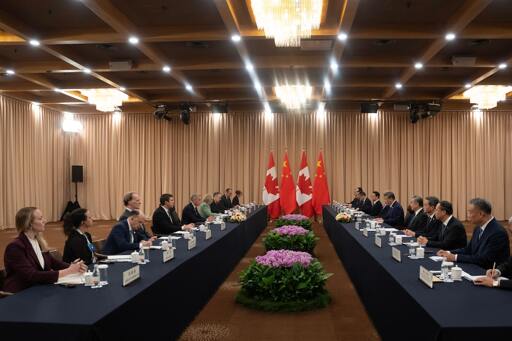
Op-ed by Margaret McCuaig-Johnston, a director of the China Strategic Risks Institute and a senior fellow of the Graduate School of Public and International Affairs at the University of Ottawa.
When Prime Minister Mark Carney visits Beijing next week his prime objective will be to improve trade ties to offset challenges from the United States.
But do we really want to pivot from our newly erratic trading partner to our even more erratic trading partner? And is that our only choice?
For years China has been touted as Canada’s second largest-trading partner, so it is tempting to see it as our best hope for a market to replace the U.S. But China is a distant second. Its market represents only 3.8 per cent of our exports, compared to 76.4 per cent for our exports to the U.S.
The European Union, on the other hand, buys 8 per cent of Canada’s exports. While China is the second-largest partner if we count only individual countries, the EU should be considered one trading bloc because of its common market. The EU is Canada’s true second-largest trading partner.
…
As well, Britain receives 3.6 per cent of our exports, just a whisker behind China. And both it and the EU take not just natural resources, as China does, but also advanced manufacturing products such as those from the aerospace sector. Unlike China, they operate by the rule of law. It is these trading partners with whom we should be forging closer ties, not China.
…
We can’t expect China to step in to fill Canada’s new American trade gap. China is not a viable destination for our sanctioned autos, steel and aluminum. Instead, China dumps its overproduction of those products in Canada, undercutting our own. Beijing wants to sell these products to us, not buy from us. For sectors reeling from U.S. trade action, an influx of cheap Chinese products would kill them for good.
For autos especially, the software and data controlled in China would also create new national security challenges. And according to Human Rights Watch, Chinese aluminum in vehicles is made in part by Uyghurs who have been subjected to indoctrination and in some cases torture.
Furthermore, the geopolitical challenges that China poses to Canada, so clearly acknowledged by Prime Minister Carney, have not diminished in any way. Whether it is national security, economic security or transnational repression, Beijing is becoming a more significant concern. It is folly to think that we can separate those threats from trade dependence on that country.
…
Helpfully, China’s ambassador to Canada, Wang Di, has provided a list of policies we have to change to ensure “stable” trade relations. We must
- give China access to our Arctic;
- welcome Chinese investment without conditions;
- drop tariffs on Chinese EVs, aluminum and steel; and
- stop criticizing Beijing’s repression of Tibetans and Uyghurs and their threats against Taiwan.
No government of any political stripe should agree to those conditions.
And Mr. Wang called on Canada to be “pragmatic,” a term that Mr. Carney has often used. For the Prime Minister, it is a recognition of “diplomacy as the art of the possible,” a phrase borrowed from the German statesman Otto Bismarck. But for the Chinese it indicates a tacit willingness to bend whenever necessary to the wishes of Beijing’s regime. Not the right message for Canada to project.
…
Beijing is currently punishing Canada with 100-per-cent tariffs on canola oil, meal and peas, and a 75.8 per cent “antidumping” duty on canola seed. All that to create political pressure from prairie farmers for the Canadian government to drop its 100-per-cent tariff on Chinese EVs – which is working. Prairie premiers have called on Ottawa to do just that.
Meanwhile China hungrily eyes our sensitive sectors, coveting Canada’s critical minerals and artificial intelligence expertise.
Canada’s Indo-Pacific Strategy, which calls China “a disruptive global power,” has laid the groundwork for deeper trade relations with like-minded countries such as South Korea, Taiwan and India, but also with countries with which we have common interests such as Vietnam. We must build on that.
Canada will continue to trade with both China and the U.S., but we must focus our efforts going forward on markets that are not coercive.
[Edit to include ‘Opinion’ to the title.]
Not only is China more erratic, we’re talking about a government that has and is still actively meddling with Canadian affairs, and is already clearly exploiting our weakness to pressure the Canadian government into doing things their way.
In all frankness, I sometimes think that, to the CCP, Canada is nothing to them but a land that shares a large border with their largest superpower rival, and if we were to bend, they would be able to use us against the US.
we’re talking about a government that has and is still actively meddling with Canadian affairs, and is already clearly exploiting our weakness to pressure the Canadian government into doing things their way.
We’re talking about the United States right?
Both are true
Still better than the US.
An arguable but irrelevant comparison. They’re both bad. Being better doesn’t mean anything when both don’t care about our plight and will actively fan the flames if it suits their purpose.
The usa always been bad. We are just selfish we didn’t care when our allies and even ourself was complicit with human right abuses. Now that we are a direct threat we start complaining about thr US
And then what? Sit around and just say “Oh we deserve this”, or “We had it coming”? The younger generation know of these transgressions, and they are ashamed of it. They don’t deserve to fully shoulder the sins of the past, not while we’re alive.
My point is that we are hypocrites. I am not saying we shouldn’t be careful about dealing with china, i am saying we should retrospect of our mistakes and that we shouldn’t go back to support the usa once trump is out since the usa will continue to do human right abuses
Oh, well, sorry I didn’t understand what your intent was, cause I couldn’t see what the connection was. I thought what you said there was a given, but you’re right to mention it cause there are those who still clinging to the idea that we can go back even when they say they aren’t.
IMO, there’s a possibility that things can get better in the US, but regardless of whether that happens or not, Canada needs to understand how its over-reliance on the States has led itself to our predicament today.
Still better than the US.
This comment has become almost funny in the meantime. It’s something like 42, the answer to the Ultimate Question of Life, the Universe, and Everything. If you run out of arguments, just say it’s better than the US :-))
Vietnam, Japan, ROK ally with the US for the same reasons.
It keeps us safe from our neighbour.
It’s bizarre that most of the comments here are shitting on the US/China when the op-ed is clearly stating that we need to get closer to our eurobros.
No trading partner can be fully trusted, but our friends in the Schengen are smaller (so they can’t bully us as easily), have similar values (much of the time), have similar environmental and labour laws.
We should be building bridges with smaller players (including smaller Asian economies) rather than (again) putting all our eggs in a single daddy state.
Edit: included asiabros explicitly.
I think this is an argument that doesn’t need to be made. Everybody knows that trading with smaller nations would be a much more collaborative endeavour than trading with US or China given the power imbalance.
“We should be building bridges with smaller players”, well of course, that sounds great. What’s missing is to actually go and look why it’s not happening (if it really is not happening, big if), what are the tradeoffs, otherwise it’s just like saying “we should lower inflation” without adding anything material to the discussion.
Asian totalitarian State vs Nord American Fascsist State 🤔 hmmmm which one