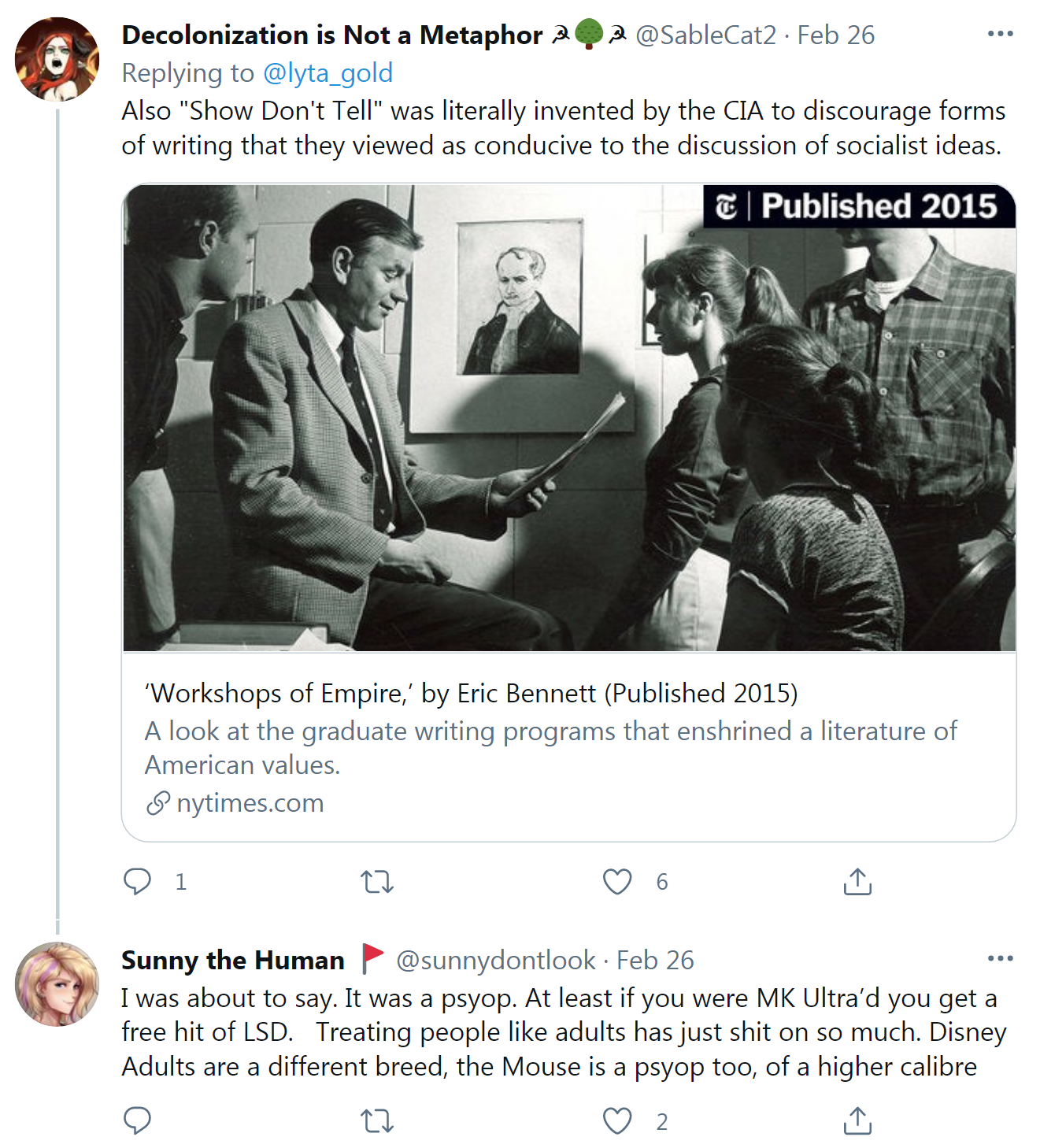
Text of the NYT Article:
By Timothy Aubry
Nov. 25, 2015
Less than a lifetime ago, reputable American writers would occasionally start fistfights, sleep in ditches and even espouse Communist doctrines. Such were the prerogatives and exigencies of the artist’s existence, until M.F.A. programs arrived to impose discipline and provide livelihoods. Whether the professionalization of creative writing has been good for American literature has set off a lot of elegantly worded soul-searching and well-mannered debate recently, much of it in response to Mark McGurl’s seminal study, “The Program Era.” What Eric Bennett’s “Workshops of Empire” contributes is an understanding of how Cold War politics helped to create the aesthetic standards that continue to rule over writing workshops today.
Sponsored by foundations dedicated to defeating Communism, creative-writing programs during the postwar period taught aspiring authors certain rules of propriety. Good literature, students learned, contains “sensations, not doctrines; experiences, not dogmas; memories, not philosophies.” The goal, according to Bennett, was to discourage the abstract theorizing and systematic social critiques to which the radical literature of the 1930s had been prone, in favor of a focus on the personal, the concrete and the individual. While workshop administrators like Paul Engle and Wallace Stegner wanted to spread American values, they did not want to be caught imposing a particular ideology on their students, for fear of appearing to use the same tactics as the communists. Thus they presented their aesthetic principles as a nonpolitical, universally valid means of cultivating writerly craft. The continued status of “show, don’t tell” as a self-evident truth, dutifully dispensed to anyone who ventures into a creative-writing class, is one proof of their success.
Bennett’s argument is a persuasive reminder that certain seemingly timeless criteria of good writing are actually the product of historically bound political agendas, and it will be especially useful to anyone seeking to expand the repertoire of stylistic strategies taught within creative-writing programs. That said, some sections are better researched than others. His chapters on Stegner, Hemingway and Henry James lack the detailed institutional machinations that make his account of Engle’s career so compelling. Moreover, he uses the early history to support his claim that creative-writing programs continue to bolster a pro-capitalist worldview today. But a chess move made to solve specific problems can serve unexpected purposes when the situation on the board has changed. Whether or not the aesthetic doctrines currently championed by writing workshops perform the same political function they once did, now that the very conflict responsible for their emergence has ended, is a question that requires further study.
Finally, despite Bennett’s misgivings about creative-writing workshops, his book is itself a convincing argument in their favor. A graduate of the Iowa M.F.A. program, Bennett has produced a literary history far more enjoyable than the typical academic monograph, for all the reasons one might guess. It features a winning protagonist, Engle, the ebullient poet-huckster and early director of the Iowa Writers’ Workshop, who, according to Bennett, “moved too quickly through the airports and boardroom offices to bother with the baggage of complex beliefs.” Here and elsewhere, Bennett never tells when he can show. The 1920s, under his scrutiny, consists not of trends, but of “racy advertisements, voting mothers, unruly daughters, smoking debutants, migrating Negroes, Marx, Marxists, Freud, Freudians and the unsettling monstrosity of canvasses and symphonies from Europe.” Wallace Stegner, he observes, “wrote at length about not sleeping with people.” Whether novelists and poets should make room in their work for the intellectual abstractions that prevail within academic scholarship, the academy would be better off if more of its members could attend to concrete particulars with the precision and wit that Bennett brings to his subject. Indeed, they might even benefit from taking a creative-writing class or two.
WORKSHOPS OF EMPIRE
Stegner, Engle, and American Creative Writing During the Cold War
You must log in or # to comment.
Wtf.
Tolstoy, usually regarded as the best writer, violates this rule constantly. His narrator turns to the camera all the time and says: “and that’s why Jesus is awesome, folks!”
Flaubert (usually ranked second best writer) never does this, however, even though the guy is a lib. Show, don’t tell might actually originate with Flaubert saying that a writer should be like god in the universe: present everywhere and yet visible nowhere.
Nabokov, America’s favorite writer, would constantly go on anti-Freudian, anti-communist rants in his books.
Joyce obviously has some issues with British imperialism. Etc.
I write communist fiction but I struggle to keep from going on leftwing rants because it annoys me when I encounter it in other stories. I do ultimately think it’s better to work this shit into the narrative (like in The Sopranos, probably the most leftwing “thing” America has made in decades). I tell myself that if I want to rant, I should write an essay. If I want to tell a story, I should tell a story.
Zola is a leftwing writer who does a very good job of being leftwing while showing and not telling. I’ve read The Human Beast, Germinal, The Lady’s Paradise, and some of The Debacle and Nana, and it’s all great.
I never set out to write communist fiction when I started writing for fun as a kid, but I ended up with it being the only thing I manage to consistently get words on the page for. My thing is to take the classic Cold War spy novel, use all the same awful tropes, but twist the perspective so that the Soviets are the good guys. Don’t actually write either side’s agents as different kinds of people than how most of this genre writes the archetypal characters, just shift the perspective and who wins. The Americans are still arrogant but charismatic smooth talking dudes Defending the Free World, the Soviets are still terrifying women fanatically devoted to ideology with crazy Soviet Superscience gadgets. Writing a complete subversion of Cold War tropes is easy and has been done. Playing them straight except the Soviets are the good guys, feels more creatively challenging, and I’ve never seen it done intentionally before.
I am also working on more of a dramatized historical piece than true whole-cloth fiction, centered on church schools, small town and rural reaction and right radicalism, Cold War Christianity and the Anti Communist Crusade narrative, the kids in it definitely don’t act like normal kids, but chalk that up to the “Cold War reenactment” environment of fear that feels very real to kids stuck in it even if the war is over, and the way that they’re politicized and hassled from their first day of primary school - since each of them represents a different aspect of who I was as a child, or wish I could have been, and the incidents are a combination of real things done to me, real stories from myself or other Catholic school survivors altered to reduce the permanent harm done, and made up incidents that plausibly could have happened to me. I usually hate writing child characters, but this piece… I struggle to stick to any single piece long enough to get a decent first rough draft. This is easily one of the longest enduring and consistently worked on pieces I have in my writing folder, and also the most well outlined and the most useful parts actually written. I don’t really know why. I mean, I write Cold War setting, alt history “modern day Cold War”, and post war still picking up the pieces stuff all the time. I write kids who know too much and read Lenin and think the KGB are the good guys in Dad’s spy movies as at least side characters a lot, and it’s not like the characters work properly in different settings, so it’s not something about these kids being easier to write because of who they are, I think it’s probably just “write what you know” and the fact that I’ve known so many versions of Bishop McCarthy in so many different positions in a Catholic school system that writing him makes me viscerally angry in an energizing way.
And that it’s not really like telling an insane made up Cold War story, it’s just… taking something that happened to me or to a comrade or fellow ex-Catholic (I was never really practicing, but I was baptized and attended the infernal institution’s schools, and the term is useful and accurate enough shorthand), and telling it in a funny way, and thinking, how could I have handled that better if I had more hands. If I was the girl who edited and ran the school newspaper. If I was a known leftist with a mom who had a party card and couldn’t protect me from the school because she was in county jail for protests half the damn time, who carried a bag of pamphlets and dressed like a tiny Vladimir Lenin. If I was the boy people only hassled because he was friends with the commie agitator’s pamphlet passing son and his mom was interchurch cooperation liaison to the Orthodox at the local Catholic parish and her story about having worked “private security” until December '91 doesn’t add up. If I was the girl who wouldn’t take any shit from the school because I got enough of Mom’s overflow housework and Dad’s anger and frustration with his crappy job and crappy life and big brother’s fights with Dad at home. If I was the slightly older kid, repeating a grade thanks to clerical screwups and unhelpful office staff at every point in the school transfer, who’s been through a few Catholic schools and knows what’s what - the Cold War Living History Exhibit is new, but the methodology sure isn’t. Catholic schools accuse you of crazy shit, and arguing in principle isn’t worth it - anything they can do to you for a finite time as punishment, they will do indefinitely to try to extract a confession. Anything short of murder, the principle of the thing that you’re innocent, isn’t worth it. Just plead guilty and get the punishment over with. You wanna talk about Soviet show trials? Sit an accusation in my school’s front office, bud. At least the commies gave you a show trial. I’ve never gotten a trial. If I was the crazy combloc kid, too young to actually have been born before the wall fell but insistent she’s East German, who shows up under odd circumstances with a dad who wants to be in America and a mom who does not, who takes approaches to these idiot fascists the Western kids wouldn’t think of, while also learning Western kid tactics that she’d never have thought of, and when told she’s insane by the younger kids, just says “I’m from East Germany. What do you expect?”
And then I take those aspects, and write the funniest way they could possibly react. They still lose. The reactionaries always win in these shitholes. That’s how it works. But at least it’s funny. Yeah. It’s the mundane horror of being a child of the Cold War, even today in these reactionary little church run heckholes where the war never ended and some ancient Cold Warrior head pastor or diocesan bishop clings to power, slapping you in the face, but the slap in the face is with a rubber chicken, or a pie, because the kids are laughing with you, not inviting you to laugh at them.
I think it works because I’m not just telling a spy story with Cold War absurdism, I’m taking utter horror and making it funny. I’m using the absurdism of the Cold War, the only piece of it all I ever truly missed, to take the ways it made my childhood hell from beyond its grave, and turn those ghosts into a damn good laugh. Writing shit where the commies win is a good damn power fantasy, but something where I can write a character who infuriates me winning, but still be laughing my ass off at his pyrrhic victory or the utter stupidity of the conflict he’s won? Yeah. I don’t know if anyone will enjoy reading it if I ever actually finish it, but I’ll admit that writing for that universe is absolutely lightning in a bottle for me. (The best part is, he is a very elderly church man, prone to stress and shock. So after the kids have graduated and we’ve seen that nothing’s ever done, the only happy ending they got was outgrowing the direct control of that bastard, I get to kill him off. To replace him with one of his almost as bad and not much younger underlings, of course, but still.)
Banger post but I just realised, this is from 2021
Aww thanks.
Putting essays in novels gets them to people who might not otherwise read them. For example, I don’t read a lot of fiction, and Donna Haraway tricked me into reading speculative fiction by burying it in Staying with the Trouble
One of the most famous parts of the most famous Dostoevsky novel is where a character goes on a novella-length philosophical monologue. And it’s fantastic.
I’m pretty anti-MFA but I’m not sure on this one. If it’s a historical fact, sure, but the way “show don’t tell” is employed now by amateur critics/writers doesn’t usually have any political content (which the article notes as well: it ossified despite no longer having CIA involvement).
Chuck Palahnuik makes this archetypal argument for the rule:
Typically, writers use these “thought” verbs at the beginning of a paragraph (In this form, you can call them “Thesis Statements” and I’ll rail against those, later) In a way, they state the intention of the paragraph. And what follows, illustrates them.
For example:
“Brenda knew she’d never make the deadline. Traffic was backed up from the bridge, past the first eight or nine exits. Her cell phone battery was dead. At home, the dogs would need to go out, or there would be a mess to clean up. Plus, she’d promised to water the plants for her neighbor…”
Do you see how the opening “thesis statement” steals the thunder of what follows? Don’t do it.
But that this is totally subjective and has no argument attached is lost on Chucky. This is what many bad critics do: they do not have the acumen to point out macro-flaws in shallow/unrealistic characterization, cliches, banalities, all things that can be cogently argued & debated, so they hone in on minute flaws that, usually, only appear to them as such. I once read an article where someone said contemporary fiction was bad because their introductory sentences were too long.
But “Steals the thunder” here means nothing: I could just as easily argue that, given the first sentence, the following sentences are superfluous, so one obviously would have written the paragraph differently to begin with. “Little” Chucky can’t even leave his own style of writing for the sake of arguments. SAD!
If nothing else, cut the opening sentence and place it after all the others. Better yet, transplant it and change it to: Brenda would never make the deadline.
Thinking is abstract. Knowing and believing are intangible. Your story will always be stronger if you just show the physical actions and details of your characters and allow your reader to do the thinking and knowing. And loving and hating.
This is ironic, considering that how a character thinks & believes are actually far more indelible to a potential reader than their physical details. I used an example recently of trying to describe Satsuki Kiryuin without using her name: it’s impossible, because any non-weeb reader will imagine their own version of long black hair/thick eyebrows/stern face woman.
This is not true of “Brenda knew she would never make the deadline.” Moreover, knowing about a character allows one to set up later “show” moments, because then the reader objectively knows enough about a character to think “ah, I think this is what their expression means / what they’re thinking”. I’ll make a separate post on this later, maybe, but consider this: a character looks at a dead cat. What are they thinking?
Well, better hope I make that post to answer that.
Don’t tell your reader: “Lisa hated Tom.” Instead, make your case like a lawyer in court, detail by detail. Present each piece of evidence.
That all of this is devoid of context tells you enough, but I should note this is a fine introduction: not a great one, but a good serviceable one. A thesis statement’s purpose is to set up a story quickly. And, again, telling leads to far deeper, more subtle, and greater characterization than permanently showing.
But the reason Palahnuik and amateur critics do this with literature is, I believe, more insidious. The popularity of television & movies (worthy artforms in their own right) and subsequent crowding out of literature has led to the implicit view that it is sort of a subhuman version of art. Books that only show are easier to adapt to film/television, because they more aptly mimic it, which is what all literature aspires to anyway: besides a few old boring classics. Words are boring & plot is fast: why read when you can watch?
The obvious corollary that if you are writing a novel, you are in the only medium where you can tell, so why not use it, never occurs to these people.