

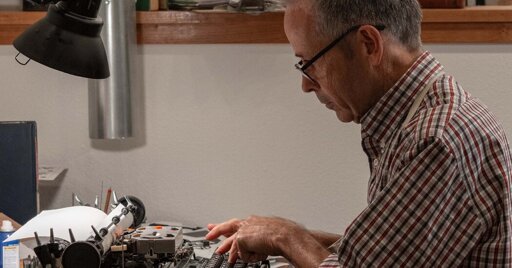
Eleven years ago, Paul Lundy was dying a slow, workingman’s death under fluorescent light.
For three decades, he had worked in facilities management — an honest trade that ground him down until, in his mid-50s, he had money, an authoritative title and a soul that was being sucked dry. He managed buildings for Seattle-area biotech firms, where people in lab coats made discoveries that saved lives. He kept the infrastructure running. He was good at it, maybe great, but facilities managers are overhead, essential but invisible. Nobody notices until something breaks.
Lundy had reached a ceiling. No college degree meant no room to grow in a world that valued credentials above experience. Retirement at 65 stretched before him like a prison sentence. The three-hour commute was killing him — a ritual that thousands endure to afford living near Seattle.
“Fun was not what you would call it anymore,” allows Lundy, a trim, neatly pleated man with a soft, welcoming face.
One Sunday morning in 2014, he opened The Seattle Times and found a feature story about Bob Montgomery, age 92, known to friends, customers and locals simply as Mr. Montgomery. The article read like an obituary for a vanishing trade — fixing typewriters — suggesting that when Mr. Montgomery went, seven decades of expertise would vanish into the digital ether.
Lundy read it once, then a second time. He had never given old typewriters much thought, but something stirred in him that he could not quite name. He showed the story to his wife, Lisa.
“I think this might be it,” he told her. The next weekend, he drove to Bremerton, a weary naval town an hour’s ferry ride away and a world apart from gleaming, digitized Seattle.
Thank you for sharing this! I had a novel idea about a typewriter repairer, this was an interesting read!