NASA EVA suits have liquid (water) cooling systems to avoid cooking the astronaut while outside the ISS.
I don’t know how they actually work though. The only way to shed the heat is to radiate it away or to sink it into warming something else up.
Found this on Wikipedia:
In an independent space suit, the heat is ultimately transferred to a thin sheet of ice (formed by a separate feed water source). Due to the extremely low pressure in space, the heated ice sublimates directly to water vapor, which is then vented away from the suit.
The ice sublimator consists of sintered nickel plates with microscopic pores which are sized to permit the water to freeze in the plate without damaging it. When heat needs to be removed, the ice in the pores melts and the water passes through them to form a thin sheet which sublimates. When there is no need for heat to be removed, this water refreezes, sealing the plate. The rate of sublimation of the ice is directly proportional to the amount of heat needing to be removed, so the system is self-regulating and needs no moving parts. During EVA on the Moon, this system had an outlet gas temperature of 44 °F (7 °C),[1] As an example, during the Apollo 12 commander’s first EVA (of 3 hrs, 44 minutes), 4.75 lb (2.15 kg) of feedwater were sublimated, and this dissipated 894.4 BTU/h (262.1 W).[2] The pores eventually get clogged through contamination and the plates need to be replaced.[3]
Though I think that’s specifically for removing the astronaut’s body heat.
What a great system. I wonder how the development of that worked. Did they theorize the necessity of a system like that or were the first space walkers quite unconfortable?
It’s also for removing the suit systems heat, and heat from sunlight. As much as we love to say space is cold, the problem things in space have is the exact opposite. Without air for the convection or conduction of heat things in space, be they satellites, a space station, or a human in an EVA suit, have a very hard time expelling heat. The International Space Station has enormous radiators on the dark side of it’s solar panels for this very reason, getting rid of heat is hard when you can’t just blow air over a heat sink.
Also, for what it’s worth, the average energy of what few particles there are in the vacuum of space tends to be pretty high, but they’re so dispersed that it’s entirely negligible.
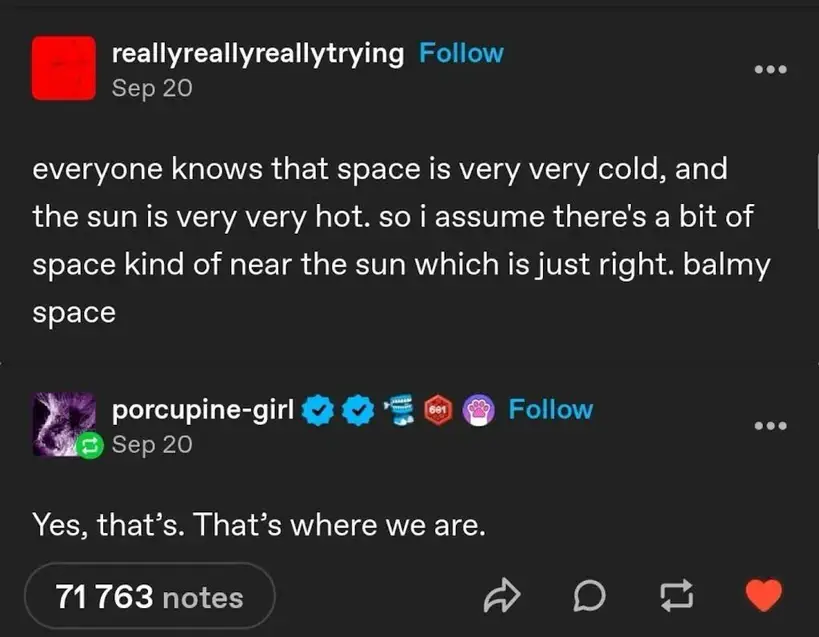
I always try to explain that space is cold on average but near a star it is really hot.
Case in point: the Earth. Standing on its surface under 100km of atmosphere, the sun will still burn your skin in minutes… imagine sunburn without the ozone layer.


NASA EVA suits have liquid (water) cooling systems to avoid cooking the astronaut while outside the ISS.
I don’t know how they actually work though. The only way to shed the heat is to radiate it away or to sink it into warming something else up.
Found this on Wikipedia:
Though I think that’s specifically for removing the astronaut’s body heat.
What a great system. I wonder how the development of that worked. Did they theorize the necessity of a system like that or were the first space walkers quite unconfortable?
It’s also for removing the suit systems heat, and heat from sunlight. As much as we love to say space is cold, the problem things in space have is the exact opposite. Without air for the convection or conduction of heat things in space, be they satellites, a space station, or a human in an EVA suit, have a very hard time expelling heat. The International Space Station has enormous radiators on the dark side of it’s solar panels for this very reason, getting rid of heat is hard when you can’t just blow air over a heat sink.
Also, for what it’s worth, the average energy of what few particles there are in the vacuum of space tends to be pretty high, but they’re so dispersed that it’s entirely negligible.
I always try to explain that space is cold on average but near a star it is really hot.
Case in point: the Earth. Standing on its surface under 100km of atmosphere, the sun will still burn your skin in minutes… imagine sunburn without the ozone layer.