

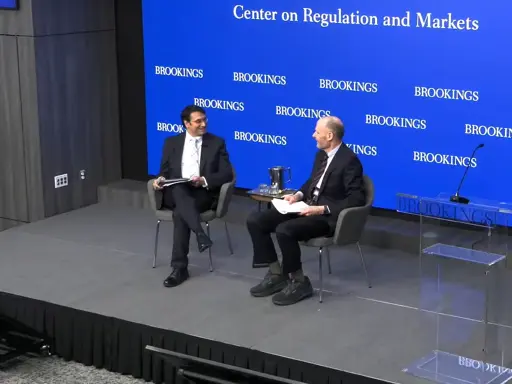
Brookings: make the data centres pay to build the power plants
https://www.youtube.com/watch?v=dYWs1HQEEHE&list=UU9rJrMVgcXTfa8xuMnbhAEA - video
https://pivottoai.libsyn.com/20260305-power-prices-data-centres-nothing-but-data-centres - podcast
time: 8 min 47 sec
Depends on which side of the Rockies you’re on. Don’t forget, only 80% of the USA is on the East side; the economics are totally different for the 20% on the West Coast. As your own source says:
California, we’ve had declining load for a long time. Our prices have increased the most. It’s not data centers. Data centers have played no role in increasing the prices in California.
Maybe you’d say that that’s unfair; they don’t have many datacenters and additionally California’s economy operates on a different scale than most of the rest of the USA. Additionally, California’s recent world-famous wildfires are partially caused by the utilities, who then have to pay to fix it up:
In anticipation of the 2022 California wildfire season, the Pacific Gas and Electric Company (PG&E) increased its planned wildfire mitigation plan spending for 2022 to $5.96 billion, from $4.8 billion in 2021 and $4.46 billion in 2020. The mitigation plan includes the ‘undergrounding’ of at least 175 miles of power lines in high-fire risk areas, the installation of 98 additional wildfire detection/monitoring cameras and 100 additional weather stations, the expansion of safety settings that cut off power when objects (such as trees or branches) contact power lines, and the continued implementation of public safety power shutoffs (PSPS) as a last resort during extreme fire weather conditions. These moves came after the company declared bankruptcy in 2019 over its liability for wildfire damage costs from the 2018 Camp Fire and 2017 Tubbs Fire, among others. PG&E pleaded guilty to 84 counts of involuntary manslaughter in the Camp Fire, shortly before the company exited bankruptcy in June 2020. In January 2022, Cal Fire determined that the Dixie Fire, the largest fire of the 2021 California wildfire season and largest non-complex fire in recorded California history, was caused by a tree contacting PG&E electrical distribution lines.
Oregon does have lots of datacenters, though, and our wildfire rates are within historical norms. What’s driving electricity prices in Oregon? According to Oregon’s state government:
In all, the top factors driving costs are as follows: [r]ising power costs[, o]ngoing infrastructure needs, compounded with inflationary pressures[; and c]osts to mitigate the increasing prevalence and risks of wildfires and extreme weather.
Why is the underlying cost of power rising, though? They go on to explain indirectly:
At the same time Oregonians have faced rising electricity prices, the electricity sector’s greenhouse gas emissions in Oregon have fallen.
They aren’t worried about data centers; instead, they are spending rhetorical points on the most politically-inconvenient cause of rising costs, which is retiring old coal plants in the name of decarbonization. Don’t get me wrong, I support switching to more sustainable and less harmful production, but I also think that my state government is being a little too quick to insist that it’s not part of the cost of electricity.
In 2021, the Oregon State Legislature enacted House Bill 2021 that requires PGE, PacifiCorp, and certain providers to, among other things, “eliminate greenhouse gas emissions associated with serving Oregon retail electricity consumers by 2040.” … Some have questioned whether HB 2021 is to blame for the recent electricity price increases. For many Oregonians, the answer is simple: no.
Perhaps it is reasonable to say that power price rises on the East Coast are driven by datacenter buildouts. I would be interested in numbers that go back about two decades and study Virginia or the Carolinas specifically; this trend could go back to the beginning with AWS’s
us-east-1in 2006.PS: Previously, on Awful, looking at Omaha, Nebraska specifically, I noted that there is a nearby abandoned nuclear power plant. There’s a nearby abandoned nuclear campus here, too! Quoting from one of WP’s articles on Satsop:
Washington Nuclear Project Nos. 3 and 5, abbreviated as WNP-3 and WNP-5 (collectively known as the Satsop Nuclear Power Plant) were two of the five nuclear power plants on which construction was started by the Washington Public Power Supply System (WPPSS, also called “Whoops!”) in order to meet projected electricity demand in the Pacific Northwest. … Today the site hosts the Satsop Business Park and the Overstock.com Call Center.
Whoops! Starting to notice a pattern here. It’s well-known that the USA has a strong NIMBY anti-nuclear sentiment; perhaps cancelling nuclear plants half a century ago is part of why we have “rising power costs” today? We may never know~
I think you’re glossing over how interconnected the grid is. California does not generate it’s own power, it buys a significant amount from Oregon. So if data centers are being built in Oregon, that will impact costs in California. For instance, there’s a DC link from the dams on the Columbia in eastern oregon that goes directly to southern California, and that area is now absolutely littered with data centers. Like a whole city of them right by the dams. They are there specifically for the cheap land and cheap hydro energy. And they use A LOT. Obviously I’m not packing any numbers here but I also wasnt born yesterday. Zero chance that all that load, there specifically, isn’t impacting prices.
Raise the prices for the data centers to offset the cost of the regular consumer?
Insanity!
Think of all those poor billionaires who won’t be able to afford that 29th yacht if we made them pay their fair share instead of externalising their costs onto an already stretched general.public!
