

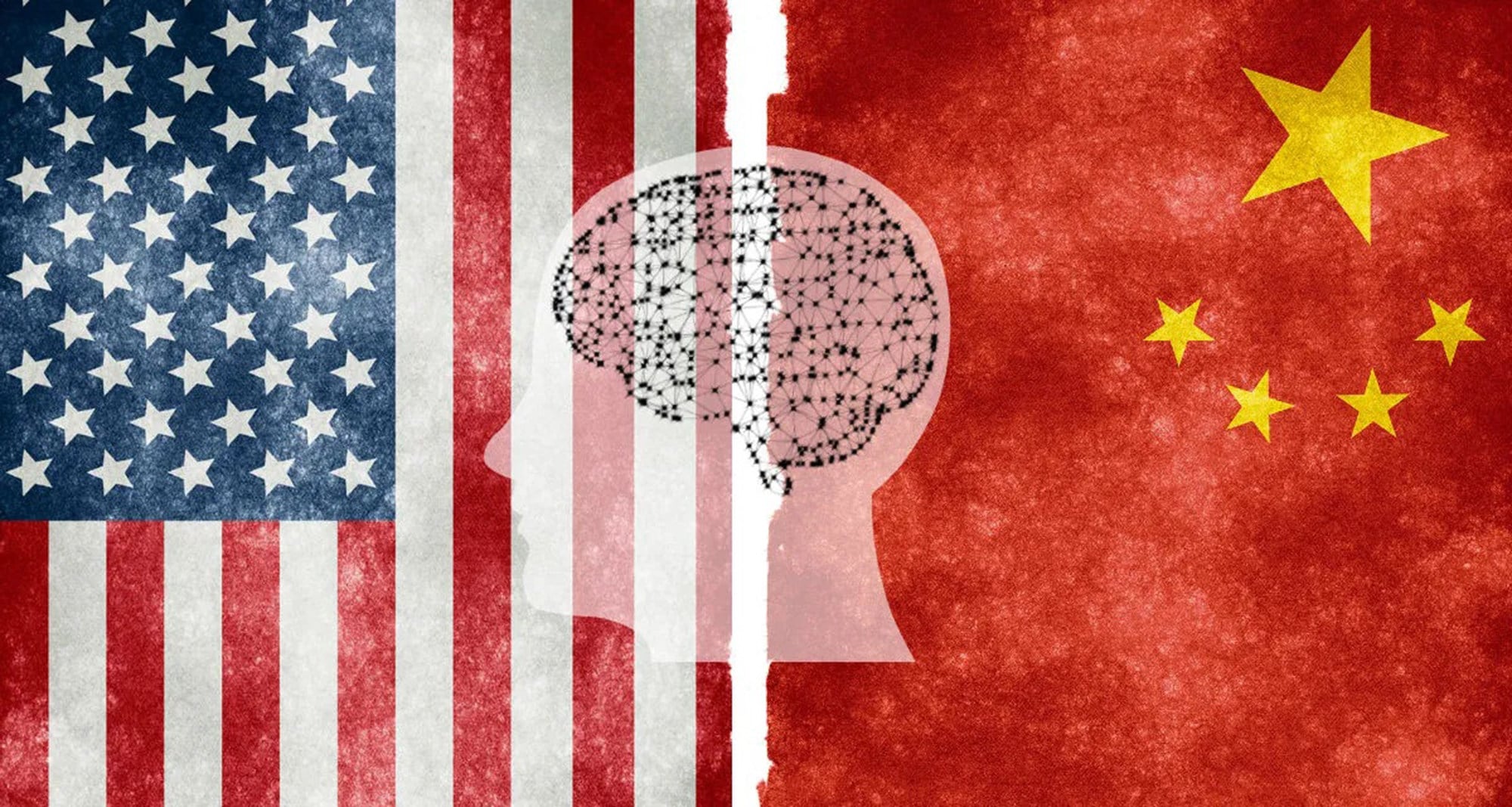
The US and China are competing for global leadership in artificial intelligence as the technology rapidly advances. Photo: Shutterstock
The United States should start preparing for scenarios where extreme measures must be taken to stop China from achieving artificial general intelligence (AGI), according to a former White House official, including state-backed espionage and military strikes on Chinese data centres.
Jacob Stokes, deputy director of the Indo-Pacific Security Program at the Centre for a New American Security (CNAS), said at an online event on Thursday that various US agencies, including the Department of Defense and the National Security Agency, should begin assessing what intelligence they need to justify taking such actions.
“Trying to think through the particulars of that will be especially important, in part because it will help policymakers … start to work backwards based on the unique nature of the technology, in the same way that in a past era, policymakers would learn about nuclear weapons and … work backwards from the science to the policy implications,” he said.
In a new CNAS report published last week, the former Obama administration national security staffer called for the US government to consider the feasibility of diplomatic, espionage, cyber and kinetic measures to prevent China from achieving AGI first.
AGI is a hypothetical AI system that can achieve human levels of performance across a wide variety of tasks. The report, titled “Superpowers and AGI”, explores how the imminent arrival of AGI might affect US-China geopolitical competition.
The US currently enjoys a months-long lead over China in frontier AI models, according to Epoch AI. However, China could make a “surprise technological breakthrough” that means it is close to achieving or achieves AGI first, Stokes wrote, citing China’s advances in areas such as robotics and other forms of “embodied AI”.
If this were the case, the US government should consider extreme actions such as military strikes on the data centres that train and run the Chinese AGI system, Stokes wrote, including preventive strikes before China develops AGI.
As AI technology grows in importance economically and militarily, the data centres that form the backbone of the AI industry have emerged as military targets. In March, Iran bombed Amazon data centres in the United Arab Emirates and Bahrain as part of its conflict with the US.
According to Stokes, US government agencies would have to work out what facilities to attack and with which weapons, while considering the risk that the strikes lead to a general war between the two countries.
William Hartung, an arms analyst at the Project on Government Oversight, a Washington non-profit organisation, also warned that any strikes on Chinese data centres would “risk starting a shooting war between two nuclear armed powers that could have tragic consequences for all concerned”.
“Striking Chinese data centres based on how they might or might not be used in the future would be the height of recklessness,” he said.
Another option would be to reverse engineer or “steal” China’s AGI technology, Stokes wrote, which would be justified “legally and normatively” because of China’s own alleged history of stealing US intellectual property.
However, he noted that the US government and intelligence apparatus have “not been organised for espionage to gather technological secrets for decades”.
The stark assessment comes as US President Donald Trump and Chinese President Xi Jinping are set to have talks in Washington later this month on AI governance as the technology continues to improve, posing growing risks to national and global security.
The “best case scenario” for the talks is that the two sides find the talks “constructive”, Stokes said on Thursday, rather than any expectations of any breakthroughs on key governance issues.
The “AGI is coming” propaganda getting real creative lol
Wait, the predictive text generator isn’t intelligent just because it wraps some of the text in <thinking>tags</thinking>?
This entire fucking country is just racism and unga bunga smash
We must start a war with a nuclear armed peer power, for we on the precipice of losing the magic bean race. I have credible intel that the devious celestial menace is on the precipice of inventing a magical genie, or perhaps stealing our magical genie that silicon valley insists exists but quite infuriatingly will not let me see. The only acceptable solution is nuclear war. We cannot allow a magic bean gap to occur.
This is a real danger and I am a very serious person who should influence what the professional violence men of the imperial death and horror machine do.
china is inventing akinator

If we wave a white tee shirt with one hand and a “liberate me” sign with another, can we have belts, roads, education and healthcare?

We cannot allow a magic bean gap to occur.

On a slightly encouraging note, you can see that capitalists are trying their damndest to make thjs the new red scare, but your average prole couldn’t care less. I’ve only heard this rhetoric about “needing to beat China” being touted by mid-level management/MBA-types
Why are Americans incapable of finding solutions to problems that don’t involve killing the problem
You would take away their founding principles?!?

I got a very American solution for this shit! Anytime some think tank suggests we just have a nice little WWIII and destroy all life on earth, we round them up and do America things to them!
I don’t know, but i’m going to start killing people until I find out!
This is the American way
I have news for them if they think they’re winning any war.
When all you have is a nuclear arsenal, everything looks like a nuclear bomb target
cuz it’s hard
we’re making up new kinds of guy just so we have more guys to kill
Jacob Stokes, deputy director of the Indo-Pacific Security Program at the Centre for a New American Security (CNAS) […] the former Obama administration national security staffer called for the US government to consider the feasibility of […] kinetic measures to prevent China from achieving AGI first.



 it’s the only way to get Lake Ontario and the Gulf of Mexico’s names fixed!
That’s what cracked me up, too.
Gotta get them preemptive strikes in before it’s ‘intelligent’ - then it’d be a crime to kill it.
🤭
The truth is coming out ai is being rushed out as a super weapon to cripple chinas economy with massive hack capabilities. Every accusation is a confession.
But I was told capitalism encourages and welcomes competition
I am urging China to level Washington D.C. and perhaps New York City
 data centers are fair targets, I’m sure there’s some close enough to justify New York, and obviously the capitol of a terrorist state is perfectly justified.
Don’t forget the option of using the military against the US bond market to make it lower interest rates. Maybe do that one first.
https://www.yahoo.com/news/politics/articles/trump-suggests-military-bond-markets-222513278.html
bring down soaring
Do they have enough missiles left to stop things from flying?
Obviously, high yields are good, and low yields are bad, so the way you help the bond market is by raising yields, which is a clear strength of militaristic intervention.