Capitalism started when some no-nobles started having more power than (some) nobles. Meaning that the power balance shifted from nobles to capitalists. Which happened around (because of) the industrial revolution.
All of these undoubtedly existed before the industrial revolution: war, monoculture farming, clear cutting forests, building on floodplains, development that destroys habitats.
These were impossible before the industrial revolution for technological reasons: space tourism, deep sea mining.
This is impossible without capitalism for semantic reasons: corporations bulldozing ecosystems for endless “growth”. Before capitalism, it wasn’t corporations, and it wasn’t done with a bulldozer. But kingdoms did “bulldoze” ecosystems. And communist countries did bulldoze ecosystems too.
Golf, lawns: these are harder to prove and I don’t care enough to do the research. Golf probably couldn’t be done before industrial revolution, but maybe a primitive version of golf could be played.
So at most, the tweet might be right in the best of cases about golf and lawns. Which would make for a much more boring tweet.
the inherent problem with capitalism is that people strive for something. the moment that you want your situation to be B instead of A, you are unhappy (with A). that is how ambition inherently creates unhappiness. there is nothing you can do about it. only way to solve this would be to never strive for anything, but that’s not gonna happen for the vast majority of people.
and the same also goes for larger macroeconomic situations. if you want to have a nice boat, you gotta chop down some trees for wood. so you’re sacrificing a part of the peace of the landscape, for your ambitions. even if it’s the ambition of a whole country. you’re still sacrificing something.


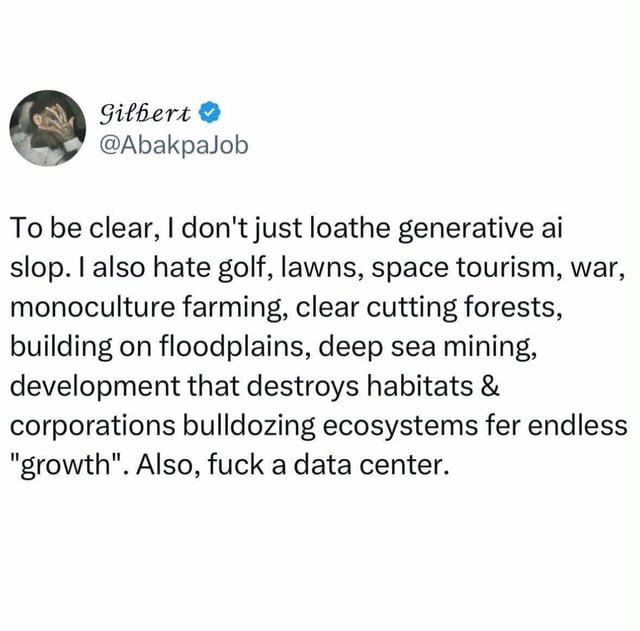
You can just call it capitalism. Almost every problem with everything listed is actually a capitalism problem not something inherent to itself.
All of those existed way before capitalism. Except the ones that require technology more advanced than what they had available.
And several of them were/are issues in “non-capitalist” countries like the USSR and China. (Though, to be fair, those are still state capitalist.)
deleted by creator
Capitalism started when some no-nobles started having more power than (some) nobles. Meaning that the power balance shifted from nobles to capitalists. Which happened around (because of) the industrial revolution.
All of these undoubtedly existed before the industrial revolution: war, monoculture farming, clear cutting forests, building on floodplains, development that destroys habitats.
These were impossible before the industrial revolution for technological reasons: space tourism, deep sea mining.
This is impossible without capitalism for semantic reasons: corporations bulldozing ecosystems for endless “growth”. Before capitalism, it wasn’t corporations, and it wasn’t done with a bulldozer. But kingdoms did “bulldoze” ecosystems. And communist countries did bulldoze ecosystems too.
Golf, lawns: these are harder to prove and I don’t care enough to do the research. Golf probably couldn’t be done before industrial revolution, but maybe a primitive version of golf could be played.
So at most, the tweet might be right in the best of cases about golf and lawns. Which would make for a much more boring tweet.
That was a huge waste of effort trying to educate somebody that doesn’t care to learn new things.
Wasn’t a waste though, I read it. 😄
https://en.wikipedia.org/wiki/History
are you really that ignorant? Have you failed that much in basic, elementary education or are you just intentionally being stupid?
But… But… Number must go up!
the inherent problem with capitalism is that people strive for something. the moment that you want your situation to be B instead of A, you are unhappy (with A). that is how ambition inherently creates unhappiness. there is nothing you can do about it. only way to solve this would be to never strive for anything, but that’s not gonna happen for the vast majority of people.
and the same also goes for larger macroeconomic situations. if you want to have a nice boat, you gotta chop down some trees for wood. so you’re sacrificing a part of the peace of the landscape, for your ambitions. even if it’s the ambition of a whole country. you’re still sacrificing something.