I was under the impression that the chemicals involved in recycling paper products, combined with the fact that virgin paper is almost entirely sourced from managed, quick-growing tree farms, make paper recycling also undesirable?
Have heard similar things. And it’s also true that timber farming is a (very marginal) form of carbon drawdown, assuming the wood products are not burned. But then in theory recycling could allow some of that land to return to nature, which better in all ways. It’s a systems problem.
The chemical issue is presumably bleaching for white paper. But thick brown cardboard is basically just degraded wood fiber so that at least must be pretty efficient to downcycle into toilet paper.
Update: there’s also another chemical issue in de-inking, maybe that’s what you were referring to. Personally I don’t bother recycling my tiny amounts of paper waste, for these reasons. Thick cardboard must be a win though.
Yup! Those things are easy (comparatively) to recycle because they’re single material items, so the process is:
clean
break down / melt
rebuild
“Plastic” is thought of as a single material, but even vegetable packaging will be made of around 5-10 different polymers, so for it to be valuable, you need to break it down back to those original polymers.
It’s not a issue with recycling as a whole, its specific to plastic as a material.
That’s just not true. I make flexible packaging and we use thousands of pounds of post industrial resin (made from scrap material produced in house) and post consumer resin (made from used packaging.) They’re all coextruded; frequently made up of 10+ different types of polyethylenes, polyamides, and ethylene-vinyl alcohol.
I don’t think “not true” is fair- I have a soure if you’d like to hear it from someone more authorative than some random internet person (unfortunately I think it might be behind a paywall)[0]
Either way, that’s cool! I’m surprised you can build flexible packaging from that, but I’d be really, really surprised if you can use something that crude to fit the other niches of plastic like building technology, clothing, etc.


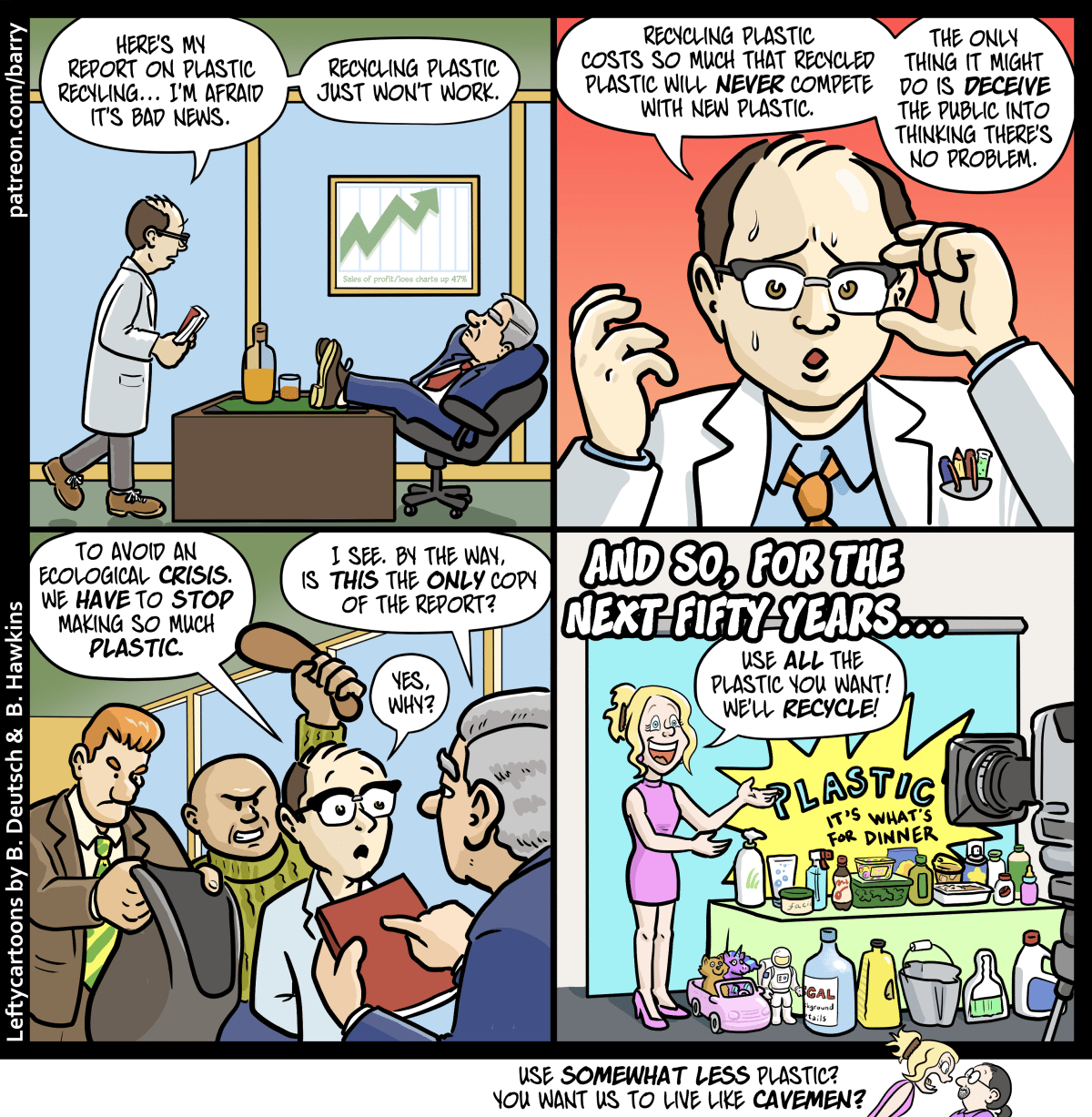
Right now it looks like paper and metal recycling is still good as far as I can read in two minutes. If someone has a correction let me know.
Correct. Paper (PS: or at least brown cardboard), glass and alu will always be great candidates for recycling.
Aluminum is the poster child for recycling, really. It takes more energy to extract it from the ore than it is to recycle it.
Former aluminum process engineer: This^
I was under the impression that the chemicals involved in recycling paper products, combined with the fact that virgin paper is almost entirely sourced from managed, quick-growing tree farms, make paper recycling also undesirable?
Have heard similar things. And it’s also true that timber farming is a (very marginal) form of carbon drawdown, assuming the wood products are not burned. But then in theory recycling could allow some of that land to return to nature, which better in all ways. It’s a systems problem.
The chemical issue is presumably bleaching for white paper. But thick brown cardboard is basically just degraded wood fiber so that at least must be pretty efficient to downcycle into toilet paper.
Update: there’s also another chemical issue in de-inking, maybe that’s what you were referring to. Personally I don’t bother recycling my tiny amounts of paper waste, for these reasons. Thick cardboard must be a win though.
Yeah same and I hate when people just say well might as “well not recycle at all then” :/ that kind of defeatism doesn’t help either
That is the point at which you remind them they are focusing on the worst R and remind them of the other two which are much more ppwerful
Maybe i should recommend DDD instead of RRR 🤫 lotta assholes running around still doubling down on dooming everybody
Yup! Those things are easy (comparatively) to recycle because they’re single material items, so the process is:
“Plastic” is thought of as a single material, but even vegetable packaging will be made of around 5-10 different polymers, so for it to be valuable, you need to break it down back to those original polymers.
It’s not a issue with recycling as a whole, its specific to plastic as a material.
That’s just not true. I make flexible packaging and we use thousands of pounds of post industrial resin (made from scrap material produced in house) and post consumer resin (made from used packaging.) They’re all coextruded; frequently made up of 10+ different types of polyethylenes, polyamides, and ethylene-vinyl alcohol.
I don’t think “not true” is fair- I have a soure if you’d like to hear it from someone more authorative than some random internet person (unfortunately I think it might be behind a paywall)[0]
Either way, that’s cool! I’m surprised you can build flexible packaging from that, but I’d be really, really surprised if you can use something that crude to fit the other niches of plastic like building technology, clothing, etc.
[0] https://www.economist.com/podcasts/2025/04/23/are-microplastics-harming-your-health
They also both have the advantage of being things that will naturally degrade over time if left outside instead of just sticking around forever