

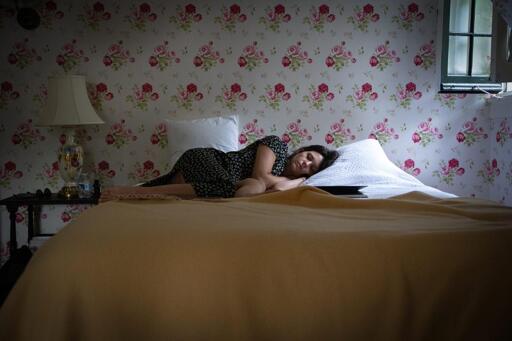
I love napping. I love napping in the summer, when rhythms are more relaxed and the guilt of taking a break less intense (if only slightly). But I also love napping in the winter, when it’s cold outside, and burying myself under a warm blanket makes me feel like I’m hibernating. No matter the season, when lying in bed, I luxuriate in the feeling of my body relaxing, waiting for the moment when odd images start forming somewhere in that space between my closed lids and my corneas – or, most likely, somewhere in my mind. I love drifting into unconsciousness without worrying about the next item on my to-do list. I’m not a sound sleeper or someone who falls asleep easily at night, but napping comes easily and sweetly. I treasure the days in which I can nap. And I treasure even more the nights in which I sleep long and well.
Yet our culture prizes efficiency and productivity, often seeing sleep as a waste of time. ‘Tech bros’ boast about regularly working more than 70 hours a week, and aim to reduce their sleep time as much as possible. Elon Musk suggested even more intense work schedules for government workers during his time at the US Department of Government Efficiency (DOGE). His approach resonated with many adherents of the Silicon Valley grind culture, which has sought to ‘hack’ sleep for a long time. As one CEO of a cost-cutting firm told the news site Business Insider this year: ‘While a 120-hour workweek isn’t a practical or sustainable solution for most, the principle behind it resonates. Companies that prioritise efficiency, automation and proactive cost management will always outperform those weighed down by bureaucracy.’
[…]For now, sleep remains necessary for humans. We spend roughly a third of our lives sleeping. Even though the exact biological reason remains surprisingly elusive, it is scientifically uncontroversial that getting seven to eight hours a night, on average, is vital: prolonged total sleep deprivation causes severe psychological harm, including depression and psychosis, and physical harm, including brain degeneration. Chronic sleep restriction may not be fatal, but its effects accumulate: foggy thinking and memory lapses, mood swings and irritability, weakened immunity, weight gain and metabolic dysfunction, even increased risk of cardiovascular disease.
But is the value of sleeping reducible to its health benefits? Years ago, one of my philosophy professors declared that sleeping was a waste of time, and that, if there were a pill that could make us skip sleeping, he would take it in a heartbeat. I responded: ‘But I love sleeping!’ He replied that, surely, what I loved must be the rest that sleep brings, but how could I love sleeping itself?! We are unconscious when we sleep, after all.
I’ve turned over that question in my mind ever since. When I was nursing my children, so exhausted I would have swallowed that magical pill without hesitation, sleep felt like a luxury I’d never taste again. Once they began sleeping through the night, I returned to the pleasure of it. Or did I? If I’m unconscious, am I really enjoying anything at all? And if not, does that make sleep worthless? I’ve come to believe the opposite: sleep has a value that reaches far beyond health – it is woven into what makes a life feel rich, grounded and fully lived.
I’ve read the first half at home and the second half at the techno party I’m currently at which is now only getting warmed up at 00:20. Seriously considering going home to sleep haha, the artist I came for only starts at 2 AM 🥲. Well-written article.
Wish I could listen to Insomnia - Faithless now.