

Understanding the significance of our own lives requires some understanding of scale. “Just as the microscope and telescope extended our vision into spatial realms once too minuscule or too immense for us to see, geology provides a lens through which we can witness time in a way that transcends the limits of our human experiences,” Marcia Bjornerud, a geologist, writes. The Anthropocene, she suggests, is a fine time to “adopt a geologic respect for time and its capacity to transfigure, destroy, renew, amplify, erode, propagate, entwine, innovate, and exterminate.” We need to know how to navigate our epoch: to recognize our profusion of scales and strive to understand, amidst their collisions, not just how to care for the world beyond us but how a person can be, what it means to stand as a morally vested individual.
And yet we humans are still not particularly good at seeing ourselves in time or space. I’m certainly not. So here we are. Not only has our age come face to face with an emergency of scalar challenges—brashly called a global climate crisis—but we have produced a daunting sense of distance from addressing it. The problems are physically too far away, too large, too vast; the psychological distance we feel from addressing them is too great. It’s a double-distancing. Hopelessness comes from the scalar mismatch between we individuals, who are wee individuals, and the problems of an 8,000-mile-diameter earth.
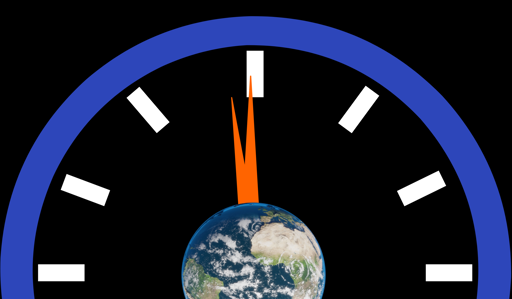
All of this was on my mind when I first met Robert Socolow, an 88-year-old physicist who, over the course of his life, turned to environmental science and technology to help humanity respond to our most complex challenges of scale. One of those efforts has been with the Bulletin of the Atomic Scientists, where Socolow helps with their Doomsday Clock. That’s the device that, since 1947, tracks humanity’s proximity to self-destruction. The clock is a metaphor, presuming to measure Blake’s hours of folly by minute and second hand; the hands are set by “nuclear risk, climate change, disruptive technologies, and biosecurity,” among other concerns. They’ve changed positions 26 times in the decades since they began metaphorically ticking. Since 2010, the clock’s hands have only moved closer to midnight.
In 2025, Socolow himself revealed the face of the clock at a press conference in Washington, DC. It was January and he was at the US Institute of Peace in Foggy Bottom. With a crowd of reporters looking on, cameras flashing and shutters digitally clicking, Socolow stood by a modernist wooden stand and spun a turntable to reveal the clock hands at a small, acute angle against midnight. A world of scalar challenges fell into an urgent sort of order. The end was 89 seconds away.
Most of us are daunted, every day, by the vastness of planetary activity and the proximity of our personal choices. We look at the clock, unsure how to balance clashing scopes of time and space. But if I’m unsettled, I want proximity to settle me. I want to be close, I want to feel part of the world I inhabit and see and feel, I want to hold those I love near to me. So what should we do? When I met Socolow, I wanted to close the physical and psychological distances in my own life before time ran out.