

cross-posted from: https://lemmy.ca/post/67952523
This is the first big step in the process to develop comprehensive guidelines for the Fedecan non-profit and the various platforms.
While this will mostly involve converting tacit knowledge and experience into an explicit written form, we expect that this process will inevitably bring up some points of disagreement on the best way to deal with different issues. We ask everyone participating in these discussions to please contribute constructively and in good faith. We encourage you to bring up any concerns or issues you have with the proposed structure and drafted guidelines, so that we can work together to fix them early on. However, in order to keep a productive environment for those discussions, we will be pruning any comment chains that devolve into personal attacks, slap fights, etc.
To help ground your feedback, consider these thought experiments when evaluating a potential guideline:
- Veil of ignorance: Would it still feel fair to you if you switched places with someone else on the platform (ex. a new user, a moderator, an admin, a member of a vulnerable group, etc.)?
- Equal Applicability: These rules will be enforced uniformly on everyone. A poorly written rule that helps “your side” today, can easily harm “your side” in the future as circumstances change.
The full guidelines, including governance details like the annual review cycle, can be found on the website: https://fedecan.ca/en/guidelines/
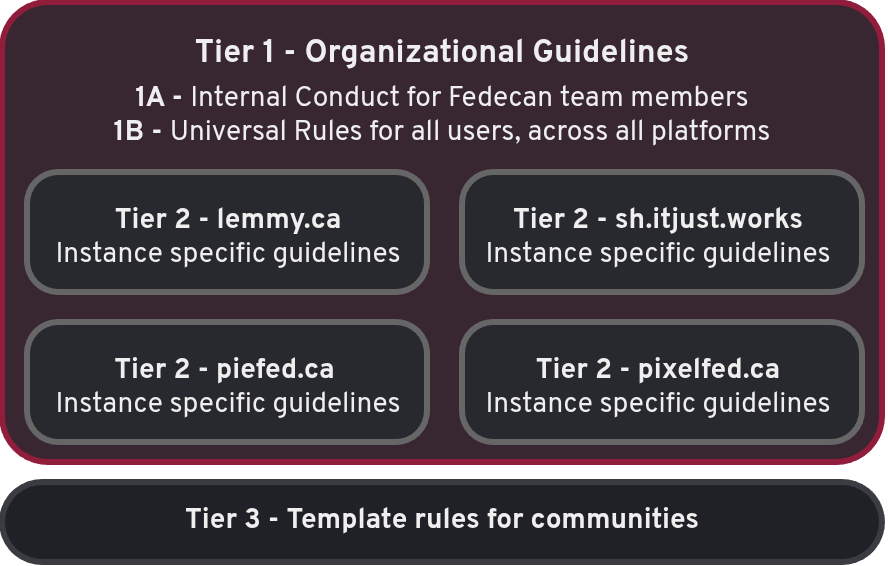
We plan to structure the guidelines as follows:
Tier 1: Fedecan Rules
Internal Conduct
These rules apply to Fedecan team members (directors, officers, admins, and anyone with elevated access). They set expectations for how team members should act.
Universal Rules
These are the baseline rules that apply to every user on every Fedecan platform. They cover the things that are prohibited by Canadian law (threats, hate speech, CSAM, non-consensual intimate imagery) as well as universal policy rules (privacy/doxxing, harassment, fraud, content that could cause harm, labelling of sensitive content, etc.).
Tier 2: Platform-Specific
Each platform has different functionality and norms, so this is where we can be more specific with the rules. The threadiverse platforms (lemmy.ca, piefed.ca, sh.itjust.works) share similar rules around community creation, moderation, vote manipulation, and content labelling. Pixelfed has its own rules tailored to its platform.
Tier 3: Community-Level Rule Templates
These are optional templates that communities can link to, or use as a starting point for their own rules. The idea is that moderators can point users to a clearly written explanation of why a rule exists, and any relevant exceptions, rather than trying to fit everything into the sidebar. Additionally, if many communities are enforcing a particular rule in the same way, then users will have an easier time understanding and following them.
The post title standards template has been drafted, and we plan to add more as the need arises. I have a few others that are in the works, but they have some overlap with the other sections, so I thought that it would be better to let people discuss first.
IANL, but just from a position of getting specific policy in place, Tier 1: Universal Rules "Prohibited by Canadian Law " should have a reference to Canadian jurisprudence, just like the “Rule 2: Hate and Discrimination” references https://laws-lois.justice.gc.ca/eng/acts/c-46/section-318.html .
Are there no Canadian legal rules around "Rule 1: Violence and Threats ", “Rule 3: Child Safety”, and “Rule 4: Non-Consensual Intimate Imagery”?
It seems these rules, as drafted, are just “nice to have’s” without a corresponding enforcement avenue – assuming of course that all users are subject to Canadian law, which is probably not the case.
I like the commitment to be against misinformation
Question about naming and shaming businesses.
How will that work? If a business or an individual tied to a business does something awful, is naming and shaming that business or individual fair game or would it be considered doxxing?
For example, not long ago I saw a post about some gym owner wearing a Nazi SS shirt. The post was naming and asking people to cancel their membership to this guy’s gym.
Another example was some guy who was recorded on video at a restaurant throwing all his garbage on the floor and clearing his table after eating by swiping everything to the floor. Generally just being a disgusting human being.
Someone found out who he was and that he owned a business, and of course everyone began to call him out on his social media accounts, as well as giving his business a poor rating and so on.
Would that type of thing be allowed?
I suggest we not allow it, and I think the proposed Rule 5 covers that case. Seeking vigilante justice on the internet is a dangerous game. It is much too easy to misidentify someone, or to act on inaccurate information. There are plenty of documented cases out there of innocent people coming to harm. Two high-profile examples come to mind:
A university professor wrongly identified as a participant at a white supremacist rally (the article includes other examples, too): https://www.bbc.com/news/world-us-canada-40935419
The Boston Marathon bombing in 2013, where a bunch of innocent people were wrongly accused and faced harassment: https://www.scu.edu/ethics/focus-areas/internet-ethics/resources/social-media-and-the-boston-marathon-bombing/
I agree when it’s at the level of internet gossip, but if a reputable news source picks it up or it’s something the business itself is verifiably bragging about it should be fair game. Last month a bakery had a sign in their window and were doing a “nuclear family” discount and the local subreddit was calling to boycott the homophobic place. And yeah they were bragging about their bigotry on Facebook and local news picked up the story. At some point I think it’s valid to allow metaphorical pitchforks.
No? How is a nuclear family discount inherently offensive enough to be worth getting out pitchforks out over? I don’t agree that being bigots is enough either. They are backwards, lots of people are backwards, and harassing them probably won’t yield any constructive outcomes. So if they aren’t actively harming others, then what are you going to achieve here.
As a broader question, who gets to be the arbiter of acceptable harassment?
I’m ganna look through this as someone who doesn’t quite understand Lemmy as well as a neurodivergent view point.
Rules are one of those things I tend to overthink and struggle to fully understand what they’re trying to tell me exactly so ye be warned if my questions on something sound odd.
———
Tier 1: Universal Rules
Content with Specific Handling> Rule 10: Sensitive Content Labelling
Mental health discussions that touch on self-harm, suicidal ideation, or eating disorders should carry a warning or a label.
Why the specificity with eating disorders and what would be considered sensitive content for said disorder? If I’m talking about eating certain foods to better my mental health, is that considered warranting of a content label? Should I be labeling all food related things with a warning? If I talk about nutritional facts for an item, is that considered a sensitive topic and I should label it?
I personally have an eating disorder so maybe thats why I’m not entirely sure what is warranting of a label because everything related to food can cause an issue.
If this is a bulimia/anorexia specific problem I think that falls under self harm, no?
———
Tier 2: sh.itjust.works
Rule 3: Vote and Engagement Manipulation
You cannot use multiple accounts to steer conversations deceptively. This includes sockpuppetry, astroturfing, or guerrilla marketing. Likewise, you cannot coordinate with other users to do the same.
I don’t know what the terms sockpuppetry, astroturfing, or guerrilla marketing mean. An asterisk with a definition somewhere in the rules would be nice. I could look it up but I worry my understanding of these terms will differ from what you’re meaning.
Rule 5: Spam and Advertising
SEO-style link spam or traffic-driving posts
I don’t know what SEO-style link spam means either…
———
I’m keeping an eye out for the AI guidelines and will have more to say about that when theres more info. Labeling AI content is a fantastic start though.
These are my thoughts! I hope the feedback was helpful in some way.
I’m just going to give you my understanding of these questions, not sure if it coincides with the intended meaning of the people who drafted the rules, so they can correct me if I’m mistaken.
Why the specificity with eating disorders and what would be considered sensitive content for said disorder?
I believe that online forums have often been implicated as contributing to and worsening eating disorders such as anorexia, and thus it’s important to be especially vigilant about creating such an environment here.
If I’m talking about eating certain foods to better my mental health, is that considered warranting of a content label? Should I be labeling all food related things with a warning? If I talk about nutritional facts for an item, is that considered a sensitive topic and I should label it?
I would say the answer is no for all of these questions. It will depend on the tone and context of the post/discussion, which is somewhat subjective. But the rule is not meant to stifle general discussion about food or nutrition, only to combat instances where such discussions become clearly and verifiably medically detrimental. I would assume that moderation action on such topics would only be taken in very clear instances of problematic patterns of behavior from certain users/communities.
Sockpuppetry is when an individual uses an alias account for any of a variety of nefarious reasons. The alias, known as a sockpuppet, could be used to agree with or praise the operator’s actual account. Alternatively, it could be used to harass other users, or create a caricature of a viewpoint or group that the user intends to disagree with or mock.
Sockpuppets could also be used for astroturfing, where an individual or group attempts to create the illusion of popular support for a position that is actually relatively unpopular among the general public. This happens frequently in politics and corporate public relations/marketing. One example would be when tobacco companies set up the National Smokers Alliance in order to protest against smoking bans and increased taxes on tobacco. It was portrayed as a collection of individual smokers who were against the increased regulations, when in fact it was simply created/funded/operated by corporate executives who were attempting to give the impression of a grassroots anti tobacco regulation sentiment among the general public.
Guerrilla marketing has some overlap with astroturfing; it’s basically when a company advertises something while trying to hide the fact that it’s an advertisement. Here’s an example (many more can be found on the Wikipedia page):
Sony Ericsson used an undercover campaign in 2002, spearheaded by Jonathan Maron, when they hired 60 actors in ten major cities and had them accost strangers and ask them: “Would you mind taking my picture?” The actor then handed the target a brand new picture phone while talking about how cool the new device was. In this way, an everyday activity was converted into a branding event.
This example would also be an instance of astroturfing.
SEO is the acronym for search engine optimization. Internet search engines such as Google use algorithms to find relevant content. By spamming a large quantity of text/links, people can attempt to manipulate the algorithm to make their content or website show up on as many different Google searches and as close to the top as possible, even when it is not actually relevant or useful information. This is referred to as search engine optimization.