Can the open source browser get its mojo back before turning into history’s footnote?
Stop cramming AI into the browser and you might get some people back.
Was on FF for years and then they announced AI so i went to WaterFox and have LibreWolf ready just in case WF starts fucking around.
I hope you know that Waterfox and LibreWolf have their fate tied to Firefox, right?
These aren’t hard forks. They consume the engineering efforts of Firefox itself in order to stay relevant. They aren’t developing their own solutions to web standards and CVE patches, except in extreme circumstances.
If Mozilla loses funding for their engineering organization, which is the grand majority of their entire budget, Firefox stops keeping up to date with web standards and security patches and rapidly falls behind. Leaving just Chrome as the only option, or Safari, but I know none of us want to choose Safari.
All the soft forks go with it.
Now, if all the soft forks abandoned their own projects in order to pool their efforts together to maintain a single fork in this scenario, then they might make some success in staving off irrelevancy, which, instead of becoming irrelevant in the course of a couple of years, might take half a decade instead. Which does leave enough time to cobble together enough contributors and a large enough project to keep it afloat.
But I highly doubt that all these various forks will pool their engineering efforts into a single project, at least not immediately and at least not willingly.
If Mozilla loses funding for their engineering organization…
It’s pretty safe to assume they won’t.
Mozilla’s funding is provided by Google. It’s not going to dry up while Google needs to maintain the appearance of a non-monopoly. It’s also the reason Mozilla is so careless with their spending.
Why would that be safe to assume? As far as I can see, the US admin wouldn’t bat an eye if Google had a monopoly on the internet standards.
Just going off a quick glance here I can see the latest Fox corpos buying Roku. There was the Bytedance merger too.
I’m not trying to argue with you, but you seems to have high hopes, and I would like to have some hope myself if you can explain your reasons to me?
Companies have a long history of funding their competitors to avoid looking like monopolies. Microsoft did it for Apple. And while the Trump administration has been allowing more mergers than ever before, two competitors in a single space collapsing into one would be very unprecedented.
But even in a scenario worse than if Google stops contributing to Mozilla, they’ll have three years worth of stored money to draw upon
On the off-chance you have some experience with of, what’s your take on Vivaldi, currently?
(edit: super curious, but how recent of an ex-reddirper would one have to be to downvote a simple request for honest input in a place where they don’t matter? Asking for a friend.)
not as great as Brave but stilla good browser
That is one of the worst alternatives you could have given, might as well say use Chrome, it’s super safe!
Also, what’s with the pushing of the football world championship?
I don’t care for it.
I also want a browser that lets me browse the web and do what I want. Not what it decides to shill next.
In someone’s eyes it might seem a small issue, but they add up.
All the resources spent on designing, implementing and testing this one-off feature that’ll be scrapped in a few weeks because it’ll outlive its usefullness is an epic waste of time and resources.
What I want is a chrome-style history page with good UX and not the history sidebar and modal from 20+ years ago.
That is a much higher ask. But do it well and it’ll serve its purpose for another 20+ years. Not a few weeks.
And it’ll actually be reasonably useful to users.
the weird fucken tab-anchored history bullshit is SO ANNOYING.
Give it a bit more time and you’ll have plenty of choices.
People are sick of the big tech crappy browsers and there are more and more open source alternatives and more and more FireFox forks that strip the crap and give you just the browser Fennec comes to mind and i bet you can ask here for options and opinions and you’ll get a ton of suggestions.
Great suggestion!
I’m a refugee from Reddit back from the API apocalypse days, so I might be suppsed to be an experienced Lemming, but I’m not.
Nor here or on reddit do I know “how” to post. What community, what to say, how to say it. I only know how to hijack others’ comments and add in my own shitty take.
I would very much like to up my browser game. I remember trying to get a userchrome that emulates the 2016-era Chrome tabs, but I had little luck. I managed to make something myself by splicing together some github repos I found, but that was a long time ago and that install is long gone.
Oh, and to avoid any ambiguity: I switched completely from Reddit onto here in protest during the apocalypse.
Dont believe the article at all. Everyone I talk to is switching back to Firefox. I never left.
Mozilla’s own numbers tells the same story. https://data.firefox.com/dashboard/user-activity
Didn’t know they have those data. Some c/dataisbeautiful material here!
Some things are really interesting. I’d expect more people with extensions, but the majority don’t use. I’d also expect more linux users, but it seems the popularity among linux users is about same level as the general users. It’s also interesting to see a reasonable amount of 32 bit systems
I’d say it’s not clear if those numbers include FF forks that still use Firefox auth and sync or not.
By default it does as they send baseline telemetry to Mozilla servers, unless fork or individual user disables it. That said, many privacy oriented forks do disable it by default so they wouldn’t be counted.
AFAIK most forks disable everything they deem privacy-problemstic, which I would assume includes all telemetry.
Those look like the numbers of the telemetry endpoints, and that’s the first thing most forks remove.
Both are true, I’m not sure I’d call it “millions per month” though…
Usage has been slowly dropping year on year since 2022 but also this year usage is up
Looks basically the same to me in absolute numbers (although good luck getting a clear picture here), lower percentage of relative users.
In the same 12 months, Brave reported a 33% increase in monthly active users.
screenshots


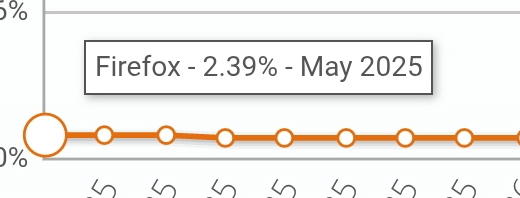
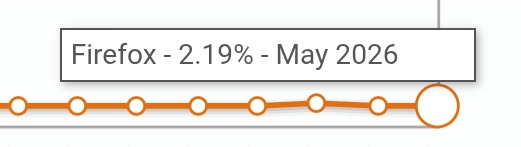
(That small rise in the previous screenshot is 2.33%)
Brave
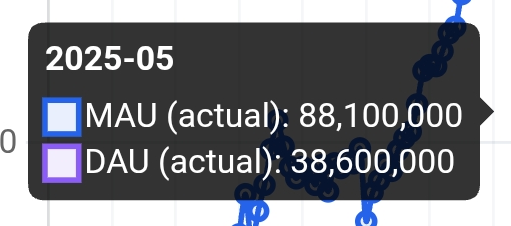

88100000 to 117600000
I was with Netscape 1.0. Never left.
Mosaic.
Never left.
(btw)
I never finished downloading Netscape from the university gopher because my roommate took the phone cable. And they only had 24 connections available to the while place.
Same, and I personally know two people who I would describe as college educated white-collar folks, but definitely not into “tech”, who recently told me they switched to Firefox.
Article is fluff, just read the source of info: https://www.firefox.com/en-US/whatsnext/
I like built in ad blocking and further privacy protection. I’d like to see more of it, to firmly establish where firefox stands in the big tech war against personal freedom.
Unpopular opinion - for me Firefox is a joy to use. I appreciate that we still have a strong alternative to web monopoly. Sure things could be better but when was this not true? I’ve used it for many many years and there’s nothing on the horizon that I would consider as alternative.
I don’t think it’s that impopular. I’ve never switched to Chrome or any derivative. I never felt a need to migrate, and with Google tightening rules on extensions, I feel even better standing by FF.
I’ve loathed the higher management giving themselves raises while market share was in free fall, but I have no complains about that piece of software. Over time, all the performance and weight issues have been dramatically improved, so what’s greener on the other side??
The Firefox forks are just so damned good. Zen, Librewolf, and Waterfox are just great.
This assumes a broad misunderstanding I keep seeing here on Lemmy.
These forks rely heavily on Firefox core engineering and development, which, if Firefox dies off, they will no longer have access to, thus relegating them to history as well.
These are not hard forks. These are forks that maintain release parity with Firefox itself, absorbing the grand majority of all engineering efforts into Firefox into their own projects, meaning they are strongly tied to Firefox’s success or demise. And “strongly” is an understatement. We’re talking 95 to 99% of Firefox engineering efforts are consumed by these forks.
So somewhere from 1 to 5% of the engineering effort these forks rely on to continue to stay relevant, secure, performant, and up to modern web standards is provided by their contributors.
Keeping Firefox up-to-date with web standards and security is an engineering nightmare. I mean, just look at Safari.
Having forks is awesome, but sitting back on our haunches, believing that they are safe, independent browser developments is absurd.
I understand the relationship between Firefox and the forks. What I meant by my comment is that I suspect that a lot of their loss in users might be because of people going to the forks rather than the main product.
I totally agree and thought about going back to plain Firefox multiple times, but I would like to argue that if you can do it better than Mozilla at basically 0 budget, that is kind of on Mozilla.
Take Librewolf and Ironfox. They have clearly shown that there is an audience for hardened/privacy first Firefox. Mozilla can capture this audience very easily: Offer it yourself.
I really don’t feel like researching all the settings I need to change to arrive at a Librewolf-ish level of privacy. I also think Librewolf could still do better. And I think Mozilla should do it better than them.
Could everything these forks do be done as an extension?
No, the changes are made at compile time and extensions don’t have access to modify many of the features being stripped out by forks.
I don’t think that’s what they implied, but you’re right. And it sucks.
Downstream. WaterFox et. al. are downstream of Firefox. “Soft” and “hard” forks are not a thing.
A hard fork means that a project forks and then doesn’t take upstream patches any longer. That absolutely happens all the time. Not for the Firefox downstreams, which are all soft forks, but those concepts are a thing.
Fork. It is called a fork.
Firefox has to die because Mozilla is a shitty org. All they care about it money. The money from Creepy Goose is just too much. The devs should move on to Servo, Ladybird, or a Firefox fork. The users will follow.
The problem is that they take their sweet time incorporating security updates.
Floorp is pretty on-the-ball from what I’ve seen!
Leaving where? There is no safe harbor. You are using WebKit, Gecko, or Chromium and thats final.
I’ve started using canada post.
Falkon will be viable aaaaany day now!
Sarcasm aside, I do hope it picks up steam. It’s a nice browser.
I actually ended up switching from Firefox to Chromium, Chromium overall is just faster and nicer to use (also a bit more secure I think, if it matters)
Ublock origin and mv3 aren’t as much of an issue as I assumed at first, ubo lite works fine

You’re about to have a rough few months, methinks.
The deprecation of Manifest V2 is almost guaranteed to kick off a glut of advertisement systems that exploit the intentional weaknesses of V3. Outside of building a uBlock Origin compatible filter system into the browser, which is what Brave did (and Mozilla copied into Firefox recently), there’s not really a way to get around this.
If chromium ever gets too shitty to use there’s about a billion other chromium based browsers like Helium that will fix the issues so
Huff that copium hufffff.
They haven’t pulled the rug yet. Good luck.
Firefox is getting shittier anyways
You’re not wrong unfortunately. Being an ethical alternative doesn’t make something automatically better, and if it does, Firefox ethics has been eroding in front of the eyes of anyone who dares to look since roughly 2017 (when they partnered with Facebook to start pushing in telemetry)
You know that V2 is just now on its way out? wait until Alphabet decides that they have waited long enough to deliver the death blow to ublock lite, which can’t update blocklists without a lengthy, weeks-long alphabet-controlled update process.
There are chromium based browsers that integrate the mv2 version of unlock origin if I ever need it
No, there won’t be. Not one of those spin-offs has the manpower available to keep V2 running when Alphabet introduces breaking changes in their code. Many of those forks have been removing (often silently) the statement reassuring their users.
Helium advertises UBlock Origin as one of their selling points so I don’t see them giving that away without a fight
Are Firefox fork users not considered firefox users? Without Firefox, the forks cease to exist. LibreWolf, etc users should be considered Firefox users.
well, but they aren’t actually using firefox…
Really hoping for the best for this browser. They absolutely need to drop ai as well as reassess their budget distribution. They are vastly overpaying their ceo.
For real. Firefox should be positioning itself as the only real alternative to the vast Blink-based “It’s all just pallet swapped Chrome” ecosystem but every opportunity Google gives them to do that instead of actually positioning themselves as an alternative, they shoot themselves in the foot. It’s gotten bad enough that people who advocated for Firefox for years have thrown their hands up in the air, given up, and moved on to other browsers without any so much hope to be positioned as a real alternative like Waterfox and Servo. I don’t think it’s being talked about enough how Mozilla has squandered all of the good will they ever had when at one point it was advocates like us who pushed it to become the only real alternative to Microsoft Internet Explorer. We were able to overthrow a browser with just as much reach into market share as Google Chrome has now, but in order to do that we need an alternative browser that is actually factually an alternative. And Mozilla just isn’t giving us one at this point
tbh it’s working really well enough now, i just wish they focus on technical stuff like optimization instead of messing with the UI and adding useless ai “features”
We don’t need ai for browsing
I’m bought in. Whatever Firefox is doing is better than Chrome in every way. The VPN feature is useless though. I can’t get any website that I actually care about to work with it turned on. Same with the email and phone number masks (Mozilla features not Firefox specific). Can’t use any Mozilla email/phone mask to work with 90% of the services I use. Amazing ideas in theory, but in practice they’re mostly useless.
I love zenbrowser, just try it and you’ll see why, I’ve left too many comments in the past detailing it, if you like swapping workspaces and having them organized without pausing all of your tabs everytime, and having essential tabs that stick around no matter what for easy access, like im jut rambling idk, it made me enjoy browsing the web again since I don’t lose tabs anymore, everything is organized in folders, pinned tabs, or essential tabs
Easily the best browser for widescreens too, vertical tabs take like a day or so to get used to, can’t go back now tho
Not too fond of it on multiple screen setups though. Perhaps that has changed? Also last time I tried it, videos played horribly (especially live like Twitch/YouTube Live)
Do you have hardware acceleration enabled?
No issues with videos, I use yt in my essential tab daily with pip and have a bunch of folders/pinned tabs for blender tutorials. In the past I would sometimes get a crash and lose tabs but that hasn’t happened in months. I use it on windows, linux on the same laptop, and linux on my handheld daily with no issues anymore.
I wish it was easier to export and import configs and bookmarks. Main reason I stopped using it.
I personally think the report of bleeding users is exaggerated, Most people I know(yes its a biased sample group) have left chrome, and its 50-49 split between brave and firefox, with the 1% being on safari(this metrics includes mobile users) and most of these people have turned on some kind of
do not track/do not send analyticscheckmark, plus people who are miffed about firefox switch to something based on firefox, which imo are just more users of firefox.No one wants the ai shit
They’re about to get a BIG bump in usership, when Manivest V2 goes dark.
I’d like to think so, but I doubt it. For the average user Manifest V2 has been gone for about a year. Sure there were commands or preferences hidden away to re-enable it, but nothing user friendly.
Maybe we’ll see a tiny bump, but I expect everyone who was going to switch has already switched.
Every month there are new webpages breaking on FF, if this trend doesn’t stop, then it’s curtains. (people increasingly don’t test their crappy JS code on FF)