

- cross-posted to:
- hackernews@lemmy.bestiver.se
- cross-posted to:
- hackernews@lemmy.bestiver.se
A Harpers contributer does the legwork and gets a head start on deflating the next dumb hype cycle.
A Harpers contributer does the legwork and gets a head start on deflating the next dumb hype cycle.
The part about robots doing backflips causes the robot to wear down faster has me thinking the whole “replace humans with humanoids” should be framed as comparative advantage rather than how many robots would be required to build itself. Given the number of humanoids required to replicate itself, you could take those same complex parts, rearrange them into non-humanoid configurations and have more output both in an interval of time and over the life time of those parts.
IMO, this grift is enabled by the miniaturization of brushless motors. It’s been a bit of an underreported revolution, but the improvements are super obvious for anyone who has handled power tools in over the last 10 years; it’s also a big deal for combat robots. You just get so much more power per kilogram of motor. These guys are lazy, so they didn’t think to consider the wear from that kind of loading in their designs.
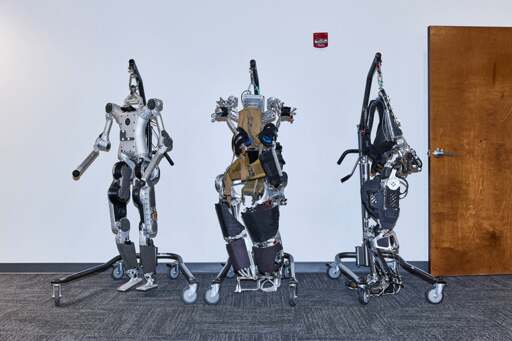
So the grifters just CAD up a believable people-shaped chassis, plonk in these new ittybitty motors, warm-over 20 year old dynamic stability research, have a few guys dance around in knitted gimp suits for the camera, and voila, they can vacuum up money from scifi-pilled rubes for years before vanishing.
Edit: also I can promote my niche hobby horse here: I maintain that Tombstone from the Battlebots tv series is the ultimate answer to these things (as well as skeleton hordes and zombie mobs).
is there a term I can google to start researching this new generation of motors?
I guess battery tech has affected this too
I’m not sure, alas. I’m only a hobbyist. It seems that improved brushless motors is a direct follow-on of the mass production of high-strength rare earth magnets, the motors being my main point of contact. (you can also draw a straight line from this to the rapid development of drones and quadcopters when combined with high capacity batteries, as you pointed out. )
In my experience, pinning down exact comparisons between brushed and brushless motors is a source of frustration since brushless torque curves behave counterintuitively at low speeds, e.g. the second chart you see here:
https://www.fingertechrobotics.com/brushless-torque.php
That behavior is why you can’t find a torque vs current draw curve for brushless motors. You can get an estimate based on kV values, but again, it is very speed dependent.
In terms of practical experience, and for speed ranges that you’ll see IRL, brushless tends to give you substantially more torque per unit mass while running quietly and with higher efficiency to boot.
I see it on my current bookshelf project, and I’m cheap so my tools are low-end stuff I could scrounge or find on sale. My old-school brushed Black and Decker 18v drill chugs when drilling holes in the old recycled hardwood we’re using for the project, wheras the brushless Ryobi 18v cuts through like it’s nothing.
Based on what I’ve seen in my fighting bots, a drop-in replacement would get you get roughly a 50% boost in torque for a similar weight of motor at the speeds concerned, unless you wanted a low speed brawler and didn’t want to gear the motor up much, in which case stick with brushed.
Sorry to carry on, it’s a whole thing!
wait is this development also related to permanent magnet synchronous generators as found in offshore wind turbines?
Not sure, but it tracks, doesn’t it?