war is peace
You must log in or # to comment.
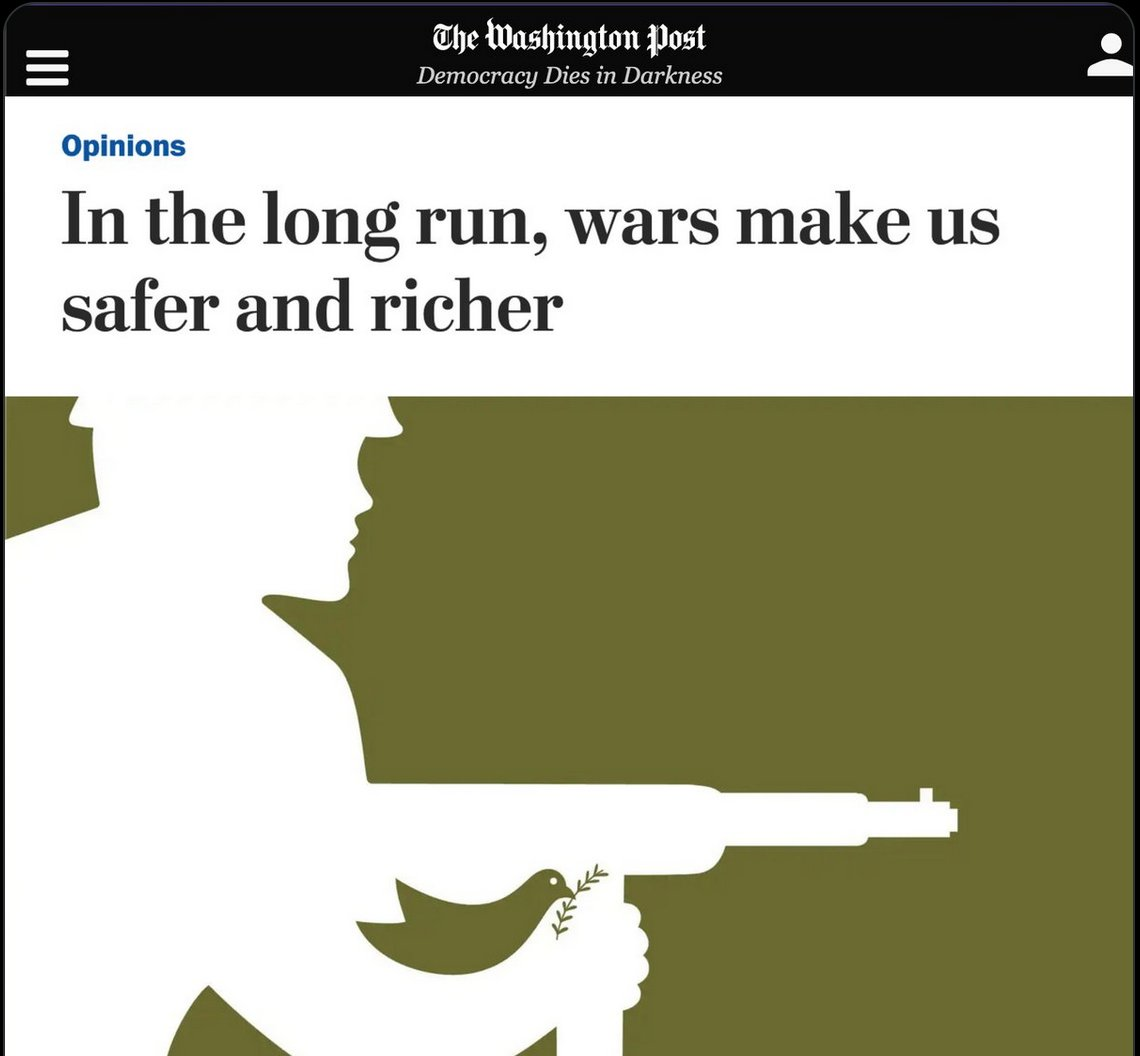
Am I the only one that sees a Wehrmact soldier with an MP-40 in hand? Like… Come on.
There is no way that is not an mp40 lmao they’re not even trying with the fascist propaganda anymore
So, not agreeing with the premise but: this article is from 2014, written by a legit historian, and is specifically not discussing the short term.
Their premise is effectively that war consolidates power and minimizes violence at scale inside the unified territory afterwards. Further, the things nations do to be ready for conflict, like build roads, administrative statates and all the social structures that accompany a standing army facilitate trade and prosperity.It’s less that he’s arguing for war, and more just … Describing the historical consequences of war in aggregate.
It was certainly only titled the way it was because he was publishing a book and this is more eye catching.
Their premise is effectively that war consolidates power and minimizes violence at scale inside the unified territory afterwards
So, the fascist “pax Romana” and its contemporary equivalent “pax Americana”. Nothing new, does the article call it by its name?
Ironic that this post is trying critize propaganda while being a bit propagandish itself
Yeah it thinks it’s counterpropaganda, but it’s just propaganda.
I agree with it of course: we shouldn’t need war to build roads today. No matter if this is how it went in the last few centuries, we should do better.
Did a war write this article?
Just a neoliberal entering his pupae to begin turning into a fascist.
You’d think, apparently it was a historian. Looks like like in the last centuries, governments would rather build infrastructure for wars than for rational reasons, but that infrastructure ended up being used for good things too.
Would be great if we could get rid of the ghouls and just build roads without needing them for war instead.
I mean I think that might have been true historically but it is not the case today.
The US obviously doesn’t really wage wars domestically anymore sp whatever infrastructure is built for these wars I would imagine presumably occurs in foreign countries. Some evidence for this point would be gestures at the general state of American infrastructure. One of the unifying features across America is complaining about shitty roads that never get fixed. And I seem to remember reading a report a little while ago about the vast majority of bridges in the US being past overdue for maintenance.
And while wars generally do generate money to some degree (increased manufacturing, i.e. ww2 lifting us out of the Depression) modern wars tend to end up with money being extracted from the taxpayer and just concentrated in the hands of the already wealthy.
I’m happy to be corrected though if anybody has any research that points to the contrary.
if by “us” they mean the billionaries behind this company then sure it does
For general context, the opinion piece was published April 2014. Bezos owned The WaPo at the time and had since 2013. Author is Stanford historian and archaeologist Ian Morris.
since 2000, the United Nations tells us, the risk of violent death has fallen even further, to 0.7 percent
Oh, so they’re only counting violent deaths, of course. You see, when you’re killed directly in war it’s very bad, but when you’re enslaved and starved because of colonialism that doesn’t count, because I’m a white author in the west!
Ten thousand years ago, when the planet’s population was 6 million or so, people lived about 30 years on average and supported themselves on the equivalent income of about $2 per day. Now, more than 7 billion people are on Earth, living more than twice as long (an average of 67 years), and with an average income of $25 per day.
Oh no, not the Steven Pinker analysis… This bullshit peddled by Gates is proven to be ridiculous because it only counts forms of consumption earned from income and not from other sources, the latter being the prevalent forms of consumption in pre-capitalist societies… Wherever capitalism arrived in the previous two centuries through colonialism, we can analyze skeletal remains from before and after and it turns out that people were shorter and weaker after capitalism arrived, meaning poorer lives and lower nutritional values… But we surely ignore this because it’s not technically a violent death!!
After Napoleon’s defeat in 1815, this was precisely what the world got. Britain was the only industrialized economy on Earth, and it projected power as far away as India and China. Because its wealth came from exporting goods and services, it used its financial and naval muscle to deter rivals from threatening the international order. Wars did not end — the United States and China endured civil strife, European armies marched deep into Africa and India — but overall, for 99 years, the planet grew more peaceful and prosperous under Britain’s eye.
Fuck you, fuck you, fuck you, absolute imperialist scum. “Peaceful and prosperous”? Fuck you a million times, genocidal piece of utter shit.
This is also still peddling the false “30 year life expectancy” that is completely not true when accounting for the high infant mortality, so the initial premise is false.
I looked at the premise of his book that this article seems to connect with, and it basically boils down to “History shows that societies becomes a lot more peaceful and productive after periods of war.”
Wow, who’d’ve thought that things get better for the people who survive a war? It’s a good thing we can apply survivorship bias to the whole of human history with such confidence like that.
“There’s less death from warfare and economic production diverted to support said warfare when people aren’t fighting wars” is a helluva argument in favor of fighting wars to improve lives and benefit the economy.
It’s like a financial advisor telling you that you should blow all your money in the casino, then quit gambling and start saving.
So it’s not that war makes things better, but that we become better off after we stop fighting? We become better off after we decide fixing our problems peacefully is a good idea? Brilliant.
It’s also not true when you consider all the times war follows war and societies see decades if not centuries of decline involving numerous civil wars. On top of that, when war is not devastating for those that start it, it does not inspire them to change; rather it becomes part of their norm.
That was not how I read the article at all. What it is arguing is essentially that people benefit from the presence of order, especially when it includes larger numbers of people, but that historically such order only tends to come about through warfare. By all means disagree with this—though you might consider reading the article if you haven’t so that you are responding to its actual points—but it has nothing to do with people doing better merely because they have survived the war.
Is that compared to the war itself, or the time before it? I have a doubt. We were all told that we were in a historic era of peace before things kicked off this month, so the bar is set pretty high. Plus, even after the dust settles, the entire Northern hemisphere will likely still be up to its collective asses in fascists with way too much power to turn around and do it again.
Thanks for sharing the link in the interest of fact and transparency.
WTF this is a real article
He seems like not a great guy.
Artist putting the dove of peace in there should be shamed, too. Mf’er thinks they have some design porn going on there when all it is is selling out to oppressors
Of course it was WAPO
It says it right at the top …
I will do one better and provide a link to an archived copy of the article so you all can read it for yourselves!
Stanford has a lot to answer for these days.
AT WHAT FUCKING COST?!?!?
Lives. Human lives, no different from yours or mine. Possibly even yours or mine, or a loved one, definitely somebody’s loved ones, a lot of somebodies actually.
Also immense financial and ecological cost and minds and bodies that will never recover. But it’s your cousin, or your classmate, or the neighbor’s kid all cut down in the prime of their lives alongside ordinary people from far away. Innocents and combatants alike.
No sane and moral person desires war unless they feel they absolutely must.
Democracy died in daylight
Define “us”.
Us, the wealthiest owners of Raytheon and Lockheed shares. Who did you think?
“When we talk about U.S.A., we ain’t talkin bout you, ése.”
Probably the author of the article and the people who paid him to write it.
You know how there a immigrants who are pro ice. Same is true across the entire spectrum of fools. This writer is not part of the “us” but thinks that by aligning themselves it some how makes them part of the group. Anyone with basic reasoning skills knows otherwise but the world is full of fools and they aren’t all illiterate.
US…A
“Democracy dies in darkness, and we’re on the side of darkness”
Democracy dies in darkness
This stopped being a warning and started being a mission statement.
Right up there with Google’s “Don’t be Evil”
That’s why Bezos has his secret mansion on the dark side of the moon.
“Yeah because after WWII there was peace!!!1”
Technically, after the war is before the war.
At the cost of murdering others and taking what is theirs.
Of courses it does, especially when you are the world’s biggest arms dealer! By far, not even China, Russia, and Germany combined, throw in UK and France, too
That’s the problem.
I didn’t even see the WaPo part of the post at first… and I didn’t need to.
Keep in mind that this is a guest opinion, which means it is not intended to reflect the official opinion of the Washington Post—in fact, it might be the opposite, but published anyway in order to provide a diversity of viewpoints. (Personally, I do not like everyone they have chosen to platform, but it is not unreasonable for them to want to err on the side of listening to what the other side has to say to avoid creating an echo chamber.)
I can’t understand how there are people who genuinely believe this argument. “Newspapers can publish anything with no responsibility as long as it says the word opinion”
Nah fuck that, that’s like posting straight Nazi gibberish and playing the “representing both sides” argument when someone calls you on it. In this day and age that whole idea can go fuck itself right into oblivion. We are all grown enough to known the difference.
It is not always the case that the side you disagree with is just a bunch of Nazis, and furthermore sometimes it is you who are wrong. That is why it is important not to be too zealous in shutting out everyone you disagree with on any issue.
Nonetheless, that does not mean that everyone should be platformed, and I am not a fan of some of the choices that the Washington Post has made in this regard, which is why I am no longer a subscriber. However, I did not think that this particular article was that bad, because it is essentially just saying that order results in far greater peace and prosperity than no order, especially when it incorporates increasingly large scales of people, but that it unfortunately requires violence to bring this about. One can very reasonably disagree, but one needs to do more than what many have done, which is to just read the title, assume that one knows what the article was arguing, and then criticize it based on that assumption.
War is bad. Good things coming about from bad things does not make the bad thing good. Especially when that bad thing is the death of who knows how many people, combatants and civilians alike. One should not need to carefully consider the idea that “maybe mass death and untold suffering is good?” because it is objectively bad. Also you type like a redditor.
Something something, act utilitarianism something something.
Obviously war is bad, which is why the idea that was actually being considered was actually “maybe mass death and untold suffering is not the worst thing, if it buys peace and prosperity for subsequent generations by building a civilization of greater scale”. As @inputzero@lemmy.world says below, one’s thoughts on this probably depends on exactly how one feels about utilitarianism.
And… is the best attack you could come up with that I “type like a redditor”? Really?
No, mass death and untold suffering is still bad. Good things that come about from bad things does not make the bad thing good, or as you put it, “not the worst thing.” This really isn’t some complex moral dilemma and I don’t understand why you feel the need to make it one. It’s bad when people suffer, the more people that suffer the more bad-er it is. Can good things come about from that suffering? Yeah, good can come from anywhere, but that doesn’t mean the suffering in of itself is justified. Also you type like a redditor.
I think that if you do not believe in your own argument strongly enough to let it stand on its own without adding bizarre criticisms of my writing style, then it is really not worth me continuing to engage. Have a good day! 😉
And I think you can’t stand the thought of “losing the argument” so you have to paint me as some facetious clown so that you may coddle your fragile ego, if we’re just throwing out random accusations now. People shouldn’t suffer. That’s not a debate point or something to argue over, it’s a fact. I don’t understand why you would want to argue otherwise, I simply cannot fathom it. Also you type like a redditor! 😉
Nonsense. The “it’s just opinion” canard is so tired, please just let it die. By publishing an opinion in a well regarded (deservedly or not) news outlet, they launder ideas into mainstream acceptability by announcing that a reasonable person could hold such an opinion. A reasonable person can not hold such an opinion as this. If it was published with a warning and an analysis of how dangerous this is and to make people aware of how the extreme right thinks, that would be one thing. But publishing an opinion without comment is endorsement, no matter how much people say it isn’t.
Bezos changed the editorial line of the paper so that conflicting views are not allowed.
Imperialist wars are, in fact, a pillar of neoliberalism, so of course they support it. They also make you richer, as the title claims, if you’re the propaganda appendage of a fascist regime, or own stocks in military corporations.
There was still some diversity of viewpoints, though it was much narrower. Still, I agree it got significantly worse, which is why I stopped subscribing to it. (I stuck around for longer than many because the reporting outside the opinion page was pretty good and I wanted to support that, but it eventually became too much for me.)
Also, out of curiosity, did you actually read the article? Because none of the points you seem to think that it makes come close to what it actually argues.
I think opinion pieces are great for matters of taste.
War, on the other hand, is about life, death, money, and politics all rolled into one giant horror-show. Publishing op-ed on such a topic, on such a well-known paper, is basically elevating -whatever- to the same level of validity as actual journalism. It’s a really bad show on the Post’s part.
So newspapers should never publish any opinions that have any commentary on warfare?
Actually, no, I really think they shouldn’t. In such matters I think it’s crucial to stick to just the facts and journalistic integrity (such as it is). Elevating personal opinion to the same level as wartime photography, reporting, data, etc. has dangerous ramifications for all involved. I’m aware that newspapers and other news/media outlets have bias, one way or another, but I think it important to draw a line and minimize that bias to the greatest extent possible; saying no to op-eds on war is such a line.
WRT to opinions and discussion on war, we have other kinds of media and public forums to serve that.
Out of curiosity, did you actually read the article? Because it neither commented on any of the wars ongoing in 2014 nor proposed any new ones.
Also, newspapers generally have a designated opinion section, and this was in that section, so it was not treated the same as factual reporting in the manner you are concerned about.
Yeah, I mean, what it said. Genocide! Love that. I respect The Washington Post and its commitment to corruption, abuse of power, and harm to kids.