I looked at the premise of his book that this article seems to connect with, and it basically boils down to “History shows that societies becomes a lot more peaceful and productive after periods of war.”
Wow, who’d’ve thought that things get better for the people who survive a war? It’s a good thing we can apply survivorship bias to the whole of human history with such confidence like that.
So it’s not that war makes things better, but that we become better off after we stop fighting? We become better off after we decide fixing our problems peacefully is a good idea? Brilliant.
It’s also not true when you consider all the times war follows war and societies see decades if not centuries of decline involving numerous civil wars. On top of that, when war is not devastating for those that start it, it does not inspire them to change; rather it becomes part of their norm.
“There’s less death from warfare and economic production diverted to support said warfare when people aren’t fighting wars” is a helluva argument in favor of fighting wars to improve lives and benefit the economy.
It’s like a financial advisor telling you that you should blow all your money in the casino, then quit gambling and start saving.
That was not how I read the article at all. What it is arguing is essentially that people benefit from the presence of order, especially when it includes larger numbers of people, but that historically such order only tends to come about through warfare. By all means disagree with this—though you might consider reading the article if you haven’t so that you are responding to its actual points—but it has nothing to do with people doing better merely because they have survived the war.
Is that compared to the war itself, or the time before it? I have a doubt. We were all told that we were in a historic era of peace before things kicked off this month, so the bar is set pretty high. Plus, even after the dust settles, the entire Northern hemisphere will likely still be up to its collective asses in fascists with way too much power to turn around and do it again.
since 2000, the United Nations tells us, the risk of violent death has fallen even further, to 0.7 percent
Oh, so they’re only counting violent deaths, of course. You see, when you’re killed directly in war it’s very bad, but when you’re enslaved and starved because of colonialism that doesn’t count, because I’m a white author in the west!
Ten thousand years ago, when the planet’s population was 6 million or so, people lived about 30 years on average and supported themselves on the equivalent income of about $2 per day. Now, more than 7 billion people are on Earth, living more than twice as long (an average of 67 years), and with an average income of $25 per day.
Oh no, not the Steven Pinker analysis… This bullshit peddled by Gates is proven to be ridiculous because it only counts forms of consumption earned from income and not from other sources, the latter being the prevalent forms of consumption in pre-capitalist societies… Wherever capitalism arrived in the previous two centuries through colonialism, we can analyze skeletal remains from before and after and it turns out that people were shorter and weaker after capitalism arrived, meaning poorer lives and lower nutritional values… But we surely ignore this because it’s not technically a violent death!!
After Napoleon’s defeat in 1815, this was precisely what the world got. Britain was the only industrialized economy on Earth, and it projected power as far away as India and China. Because its wealth came from exporting goods and services, it used its financial and naval muscle to deter rivals from threatening the international order. Wars did not end — the United States and China endured civil strife, European armies marched deep into Africa and India — but overall, for 99 years, the planet grew more peaceful and prosperous under Britain’s eye.
Fuck you, fuck you, fuck you, absolute imperialist scum. “Peaceful and prosperous”? Fuck you a million times, genocidal piece of utter shit.
This is also still peddling the false “30 year life expectancy” that is completely not true when accounting for the high infant mortality, so the initial premise is false.
Artist putting the dove of peace in there should be shamed, too. Mf’er thinks they have some design porn going on there when all it is is selling out to oppressors


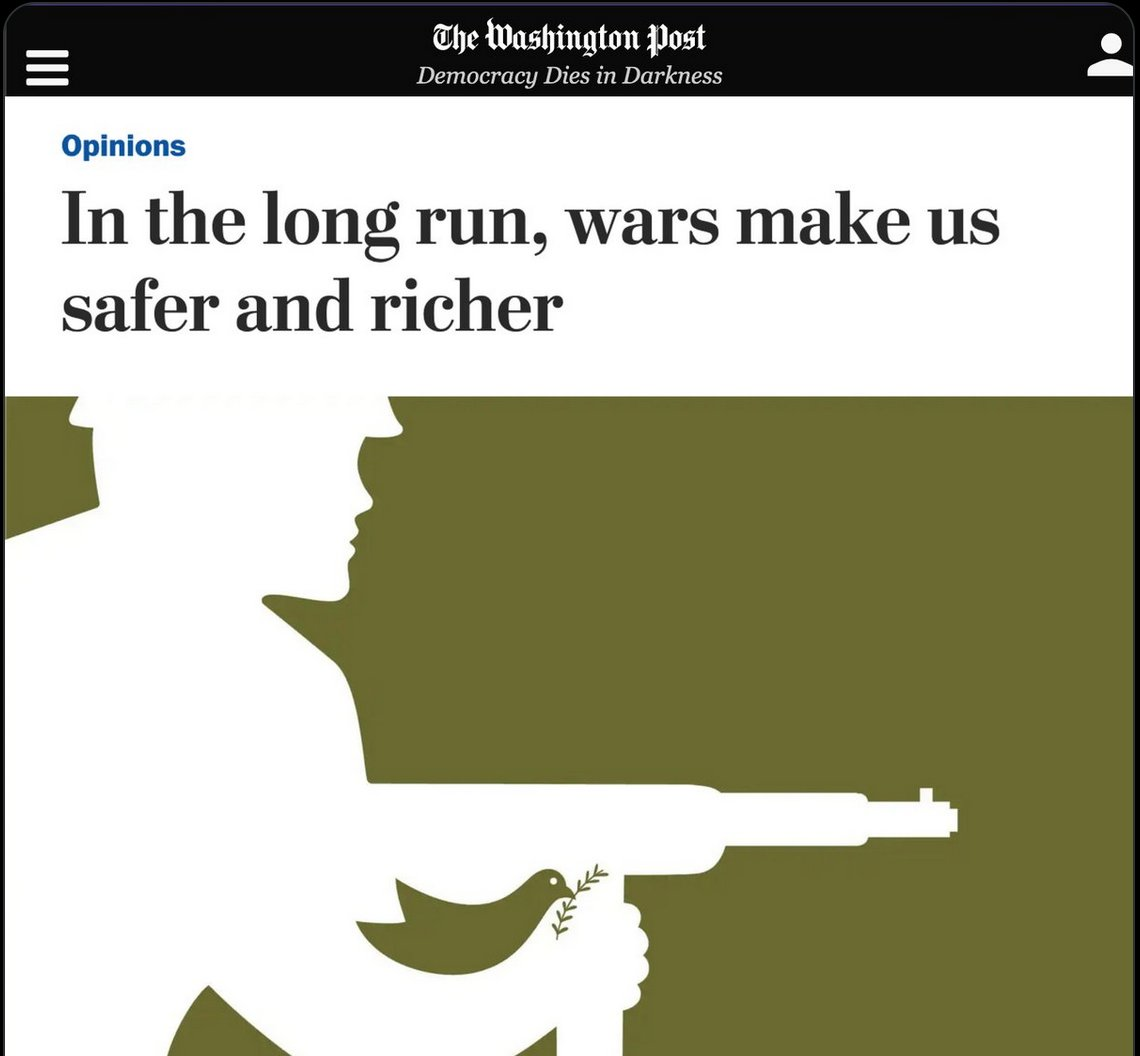
For general context, the opinion piece was published April 2014. Bezos owned The WaPo at the time and had since 2013. Author is Stanford historian and archaeologist Ian Morris.
I looked at the premise of his book that this article seems to connect with, and it basically boils down to “History shows that societies becomes a lot more peaceful and productive after periods of war.”
Wow, who’d’ve thought that things get better for the people who survive a war? It’s a good thing we can apply survivorship bias to the whole of human history with such confidence like that.
So it’s not that war makes things better, but that we become better off after we stop fighting? We become better off after we decide fixing our problems peacefully is a good idea? Brilliant.
It’s also not true when you consider all the times war follows war and societies see decades if not centuries of decline involving numerous civil wars. On top of that, when war is not devastating for those that start it, it does not inspire them to change; rather it becomes part of their norm.
“There’s less death from warfare and economic production diverted to support said warfare when people aren’t fighting wars” is a helluva argument in favor of fighting wars to improve lives and benefit the economy.
It’s like a financial advisor telling you that you should blow all your money in the casino, then quit gambling and start saving.
That was not how I read the article at all. What it is arguing is essentially that people benefit from the presence of order, especially when it includes larger numbers of people, but that historically such order only tends to come about through warfare. By all means disagree with this—though you might consider reading the article if you haven’t so that you are responding to its actual points—but it has nothing to do with people doing better merely because they have survived the war.
Is that compared to the war itself, or the time before it? I have a doubt. We were all told that we were in a historic era of peace before things kicked off this month, so the bar is set pretty high. Plus, even after the dust settles, the entire Northern hemisphere will likely still be up to its collective asses in fascists with way too much power to turn around and do it again.
Thanks for sharing the link in the interest of fact and transparency.
Oh, so they’re only counting violent deaths, of course. You see, when you’re killed directly in war it’s very bad, but when you’re enslaved and starved because of colonialism that doesn’t count, because I’m a white author in the west!
Oh no, not the Steven Pinker analysis… This bullshit peddled by Gates is proven to be ridiculous because it only counts forms of consumption earned from income and not from other sources, the latter being the prevalent forms of consumption in pre-capitalist societies… Wherever capitalism arrived in the previous two centuries through colonialism, we can analyze skeletal remains from before and after and it turns out that people were shorter and weaker after capitalism arrived, meaning poorer lives and lower nutritional values… But we surely ignore this because it’s not technically a violent death!!
Fuck you, fuck you, fuck you, absolute imperialist scum. “Peaceful and prosperous”? Fuck you a million times, genocidal piece of utter shit.
This is also still peddling the false “30 year life expectancy” that is completely not true when accounting for the high infant mortality, so the initial premise is false.
WTF this is a real article
He seems like not a great guy.
Of course it was WAPO
It says it right at the top …
Artist putting the dove of peace in there should be shamed, too. Mf’er thinks they have some design porn going on there when all it is is selling out to oppressors
I will do one better and provide a link to an archived copy of the article so you all can read it for yourselves!
Stanford has a lot to answer for these days.