You must log in or # to comment.
My attempt at an explanation
-
Ducks are dinosaurs: Ducks, as with all birds, evolved from theropods and are considered living dinosaurs.
-
Horses walk on middle fingers: Ancestors of modern horses have 5 toes the size of a small dog. Eventually they evolved away the other toes and only the middle toe remain.
-
Bees are crustaceans: Crustacea is not a single branch in the tree of life but a collection of multiple branches (i.e. paraphyletic). If we pick a point and said everything after that is considered the same group, then by necessity we have to put bees (and all hexapoda) and what we traditionally call crustaceans into a single group. That group would be pancrustacea. Is that exactly the same as saying bees are crustaceans? Are jackdaws crows? I’ll let you decide.
-
Pterodactyls are fish: Fish is also not a single branch. By the same token, if we want to put what we traditionally counted as fish (such as sharks, carps, and lungfishes) together as a single group, we have to include all vertebrates (which includes pterodactyls, us, whales, etc.)
-
Redwood are algae: I’m not too sure about this one. The wikipedia page for algae say that it excludes the land plants (embryophytes) which redwoods are part of.
-
Humans are part virus: Viruses have the ability inject and splice their genetic material into our genome and have our cells do the cloning for them. Usually it is not passed on to the next generation. Apparently an ancient strain of virus from millions of years ago incorporated themselves into our genome and our germ cells (sperm and egg) and can be passed on to the next generation.
an ancient strain of virus from millions of years ago incorporated themselves into our genome
not just one. 5-8% of the human genome comes from viruses
https://wikipedia.org/wiki/Endogenous_retrovirus just in case anyone wants a search term
And provides fertile ground for evolution by providing space for gene duplication and divergence. Likely also for miRNA control systems.
That explains a lot.
Everything is virus: one of the theories of how cells went from RNA to DNA is viruses.
Forterre (2006) proposed that early cellular lineages diversified while still harboring RNA genomes, with viruses and cells coexisting from the beginning. In his model, the first fixation of DNA occurred in viruses, which subsequently transferred the enzymes necessary for DNA synthesis and maintenance into independent cellular lineages. Thus, RNA genomes in ancestral cells were converted into DNA genomes via viral intermediates (Forterre, 2002, 2006). The structural and functional differences among cellular replication systems would then reflect the independent viral origins of DNA replication machinery.
https://www.sciencedirect.com/science/article/abs/pii/S0303264725002813
The latest puzzle: what the viroids doin’ in our guts? Nobody knows, we are only just realised they are widespread and not exclusive to flowers or whatever Anton told me. Tiny simple RNA smudges that are too simple to even qualify as a virus.
I feel like they’re as close to abiogenesis as we’ll ever get, with these living fossils.
Damn, how did the horse ancestors walk with toes the size of small dogs?
-
France is bacon
Knowledge is power.
french is fries which is belgian
Which is also waffles, so I only make pancakes.
Human are an advanced bio mech suit for bacteria. Human cells - 37 trillion (majority red blood cells). Bacteria in the human body - 38 trillion.
There is a non-zero chance that the human consciousness is the product of bacteria forming a mesh neural network that hijacks the human brain’s voluntary functions. It could explain why some people suffer emotional distress while under antibiotics (I get severe depression).
It could explain why some people suffer emotional distress while under antibiotics (I get severe depression).
More than 90% of the serotonin in your body is produced in your gut in a process that is regulated by bacteria. This serotonin not only aids in digestion, but interacts with nerves that communicate with the central nervous system to alter mood and mental health
If you experience severe depression under antibiotics, you might try to take some probiotic supplements that have strains including Lactobacillus and Streptococcus along with a helping of some soluble fiber.
The serotonin in your gut can’t pass through the gut-blood barrier, and therefore never reaches your brain, so it has no effect whatsoever on your ability to feel happy.
Unripe bananas are full of serotonin (which breaks down to melotonin as they ripen), but the only effect that has on your body is to give you diarrhoea.
serotonin in your gut can’t pass through the gut-blood barrier
I didn’t claim that it passed through the gut-blood barrier or directly influenced your cns. I said that it interacts with nerves that communicate with your central nervous system, this two way system is called the gut-brain axis.
has no effect whatsoever on your ability to feel happy
I mean, this is just incorrect .
Sorry, I wasn’t trying to claim that your gut biome doesn’t effect your mood, just that the serotonin in your gut isn’t making it’s easy to the serotonin receptors in your brain that make you feel happy
The serotonin in your gut doesn’t “directly” affect the serotonin receptors in your brain, but it does directly stimulate the vagus neve which does influence serotonin receptors in the brain. The microbacteria in the gut are also responsible for metabolizing and producing tryptophan, which the brain requires to produce its own serotonin.
So it kinda depends on how you define directly. There is an ongoing debate in medicine on how artificial the delineation between the central nervous system and peripheral nervus system really is, and whether they should even be partitioned into different sub systems for educational purposes.
Doing so is kinda a artifact of the past and has led to a lot of people attempting to define the brain as some kind of computer for the body, when in reality the functionality of the brain is really inseparable from the body.
It could explain why some people suffer emotional distress while under antibiotics
Or just that nuking gut bacteria messes with the gut brain axis…
I do like that the brain gives itself immune privilege and the blood brain barrier, it’s like “miss me with that shit” haha
babe wake up new genre of existential crisis just dropped
- ducks are fish
- dinosaurs are fish
- horses are fish
- pterodactyls are fish
- humans are fish
Some fish are fish
But not all. That would be ridiculous!
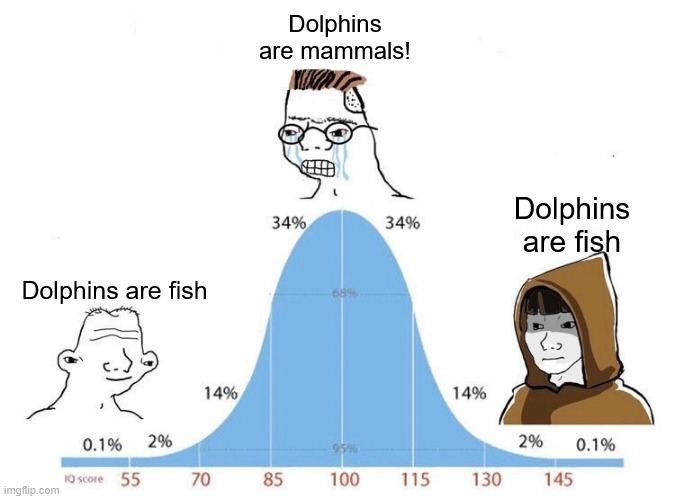
- dolphins are fish
Just a friendly reminder that, like fish, humans are coated with protective slime!
But not cartilaginous fish. That’s where I draw the line.
Lobe finned, not ray.
Eeeeeehhhhlaborate
Ducks are avians, thus descended from dinosaurs.
Anatomically, the hoof of a horse is equivalent to a human middle fingernail.
There are “sea bees” tiny crustaceans that are pollinators of underwater plants. Both crustaceans and “bugs” are arthropods.
Not sure about the pterodactyl fish reference.
Redwoods and all plants really descend from photosynthetic algae.
About 8% of the human genome is composed of ancient viral DNA from viruses that integrated into DNA…
I believe the pterodactyl, like most (all?) dinos descended from aquatic life forms. Dunno, though.
Yeah, all life from the ocean but its a bit more of a stretch to say pterodactyl are fishes.
Any scientific definition of ‘fish’ which includes all the things we commonly consider to be fish also includes basically all animal life on earth (including humans and, presumably, pterodactyls).
Edit: Though generally this is avoided by declaring that ‘fish’ is not an evolutionary category.
No argument there 🤣
Well everything is a fish or fish don’t exist.
It’s cladistics.
“Theoretically, a last common ancestor and all its descendants constitute a (minimal) clade. Importantly, all descendants stay in their overarching ancestral clade. For example, if the terms worms or fishes were used within a strict cladistic framework, these terms would include humans.”
so basically it’s a language problem, not a biology problem? people are incorrectly assuming that any group of species with a word to describe it must be monophyletic, and therefore include all unrelated species which would make it monophyletic?
I’m honestly surprised this isn’t better understood in this community, at least as an approach to the tree of life system of classification, with or without its merits. I didn’t go to college and went to public school that suppressed science education, but this was how I came to understand evolution and that all types of life had a universal common ancestor.
I’m not speaking to the accuracy of the meme, and the science community at large has its criticisms of cladistics, but I’m not sure I would define this as a problem of biology or language, or a problem at all. It is the most common method of evolutionary classification at this time.
Keep in mind I’m a blue collar worker on my lunch break and not a scientist nor college educated. I just like to learn in my free time about a bunch of stuff.
the cladistic approach developed for a reason
you know, two organisms might look similar at first, but what’s often more important is the set of internal features, such as biochemistry, tolerance of toxins, etc.
if you take all these internal features, you find that they’re well-preserved within evolutionary groups; but not within groups that merely look alike
deleted by creator
Redwoods are algae???
Yeahhh, I looked it up and I don’t know what OP meant. there are redwood lichen who live symbiotically with the trees but are separate life forms.
Then there’s the “redwoods of the sea” huge kelp like algae structures that resemble tree growth patterns but… like aren’t the actual redwood trees.
soooo yeah. I dunno.
deleted by creator
You’re forgetting our first land ancestor, the fish that decided to come up on land. By certain definitions, all land animals that descended from that ancestor are fish.
It’s an obscure biology joke. Doesn’t play into day-to-day conversations. It is the same logic that causes biologists to say that birds are dinosaurs though—because they descended from dinosaurs. But by the same logic, birds also evolved from lizards, and before that amphibians, and from before that fish, etc. This definition is more like putting all of life into nested boxes. Or perhaps it’s more like the saying “all tigers are felines, but not all felines are tigers”.
This definition is helpful for evolutionary biologists to talk about evolution at grand scale and how we might share certain genes with fish. But it’s admittedly not very helpful for day-to-day conversations that say humans are pretty distant from fish and don’t resemble them much at all now. (Though I admittedly love little biology facts like how our middle ear bones evolved from gills.)
Anyway. I get silly excited about this stuff. Random nerdy rant done.
Dinosaurs are not lizards.
Every tetrapod evolved from fish, including humans and pterosaurs.
ok well yeah I don’t disagree all terapods evolved from ancestors we call fish but then… they and we were also single cell life forms? OP is trying to say they ‘are fish’ and that’s just a random pull from history instead of direct lineage.
sorta like
pTeRodActYLs ArE StaRStUfF
I mean, all eukaryotes are Asgardarchaeota ¯\(ツ)/¯
Single-celled is physiological description, though. But I like OPs point. We have a lot of “some group except” categories. Algae (photosynthesizers except land plants), fish (vertebrates except tetrapods), some definitions of protists (eukaryotes except animals, land plants, and fungi). Practically, we use dinosaurs for the long (>65mya) extinct lineages of the clade that also includes birds. But we don’t have another name for the clade, so the point is lost.
Okay, I don’t think people would call purple bacteria algae, it is a bit more complex, algae are basically cyanobacteria and eukaryotes with plastids except land plants.
it depends on how you define algae. different authors use different conventions.
sometimes: algae = the set of all organisms that live in water and do photosynthesis
sometimes: algae = the set of all cyanobacteria
these are not the same groups.
“Pterodactyls are fish” seems disingenuous to insert when two of the previous ones are about pedantic taxonomy facts (which are true). “Fish” are paraphyletic and thus not an actual taxon, but as a practical group, it’s all non-tetrapod vertebrates – and order Pterosauria are decidedly tetrapods.
It’s trying to be pedantic in a cheeky way but just ends up being wrong.
Edit: Just so I balance this out, though, anyone wanting to be humorously pedantic about aquatic taxonomy should check out WoRMS (the World Register of Marine Species). They’ve always been, to me, the most up-to-date source on the taxonomy of marine, freshwater, and brackish biota short of reading the actual scientific literature.
I find pedants are often wrong or completely missing the point.
Sometimes it triggers a fun discussion. and sometimes it’s just tedious.
(
ghoticould never be pronounced like “fish” because “gh” only sounds like an F near the end of a word afterauorou, but ghoti is at least an interesting way to bring up the topic of weird inconsistencies of the english language, even if it’s wrong)My favorite way to slap an English speaker in the face with the silly irregularities of English pronunciation is to show them the 1920 poem The Chaos.
For those like me that never even tried to pronounce english correctly and consequently can’t grasp the actual “chaos” hidden in that poem: The chaos (YT)
Humans are full virus

Careful you don’t get banned for being an eco fascist. 🫣
Eco-rebel, TBF. ☝🏼
You know, I’m starting to think that our whole universe is just a cancerous 3+1D polyp on the ass of an entire, proper universe with more dimensions, mass, and energy, and less corruption.
Everything but that last bit, yep. Simulation or unfathomable surreality, same same. Corruption, though, isn’t a thing the universe GAF about. It’s just physics. 🤪
I can at least hope, right? Hope that whoever is on the other side of the brane isn’t as dogshit at life as humans are?
What’s a brane?
It’s the theoretical physics term for barriers in string theory. Shortened version of membrane. So, AFAIK, in that theory, our universe exists on one brane, but dark matter and dark energy would exist in another one, but their gravity leaks through because gravity is funny like that.
Theor, short for theoretically, I presume? I’m keeping up. 🤩
LOL, sorry, my phone is stupid. “Theor” is actually “their.” I edited above.
they did give mammals the placenta. since the placenta forms by forming syncitia(fusing of cells), which also some viruses induces animal cells.
deleted by creator
Humans share a common ancestor with tardigrades.
Almost everything is a worm. Not just in heredity, but also in form. You are a worm that uses long mineral deposits and muscles to stand erect and move around in an erect position for some reason. Weirdest worm.
Meat tubes.
Hoxers unite!
You can go to the endgame directly: every and all living organisms share a common ancestor.
every and all living organisms [that we know of]
The human ecosystem is so fascinating
“Humans are viruses” shuld be at the top.
A virus got your “o”.
h n !
Bill Hicks was right, “We’re a virus with shoes.”
On a more serious note, Some Assembly Required by Neil Shubin has a lot of fascinating stuff like this about evolution.