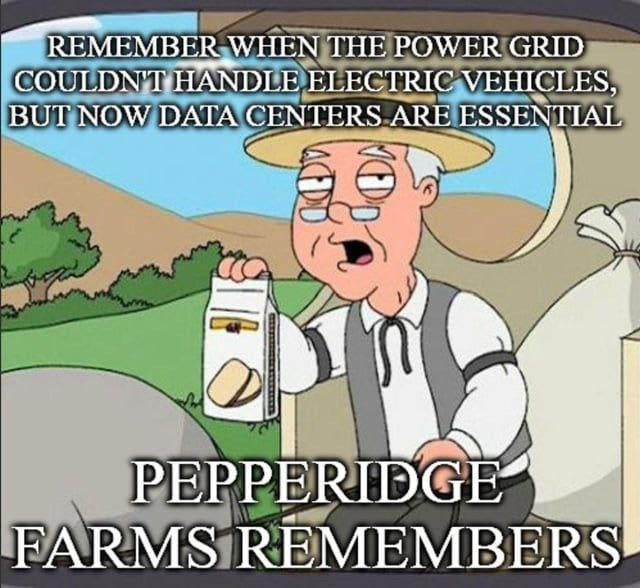

Pepperidge Farms must’ve met my dad a few years back.
Pepperidge Farms brand is owned by the Campbell’s Company. Here’s an article about how they’re embracing AI.
I was actually kind of successful in responding to the “our power grid can’t HANDLE EVs if everyone switched!” With “you’re telling me the power companies don’t want more business, and are unwilling to support it?”
They were not fully satisfied, but they didn’t have a response.
How many billionaires can the power grid handle?
At some point I think some people argued the electric chair was more humane than the guillotines. Not sure I believe that.
Who do these people think the angry mob will target when the electricity gets cut off?
Fuck that guy and fuck data centers, but this meme is misinformed.
The biggest problem with our current grid is power distribution, as in getting power from the production source to its destination (your house). We absolutely have production issues, but even if we resolve those, we still need to contend with the distribution bottleneck.
Most, if not all of these datacenter plans and include built in power production. Whether it is Google’s geothermal, meta’s nuclear, or whatver, the power production for the datacenters are meant to be relatively close to the actual.
EDIT: Let me be clear. Almost all of these dedicated power production facilities for datacenters WILL BE subsidized (or fully paid for) by local electric consumers and tax payers in the form of taxes, bonds, and electric bill fees. They are willing to do that for datacenters but not to upgrade our infrastructure (the grid) so that we can transition to EV’s.
(Sorry for this vague rant but I had to get it off my chest)
We used to build rails, roads, water/sewage systems, telephone networks and they weren’t all directly profitable. Now it seems any investment in infrastructure is deemed too expensive (unless it’s AI or whatever)
Like why is there not yet wired internet everywhere in the west. It is absolutely ridiculous that some people have to rely on starlink for a decent connection. I understand that it’s not profitable to lay miles of cable just so Bill from Buttfuck Ohio can pay $20 a month to have access to it. That didn’t use to stop us for electricity and water though. Just because some rent seeking motherfucker isn’t raking it in doesn’t mean it’s not valuable to society as a whole.
Just print some money, upgrade the damn power grid and make us less dependent on fossil fuels. It might even help the climate if anyone still gives a fuck about that.
Thats part of the backlash though.
The people, would MUCH prefer the infrastructure get updated for EVs, not just a single pipe for Data Center kickbacks to council members.
I’m not disagreeing with the sentiment, just clarifying that the grid, as it stands today, is inadequate for a full electric future. That wasn’t a lie. Clearly it is doable, they just choose not to because it isn’t as profitable.
Further proof that no amount of wealth can buy intelligence, taste, class, etc. Look at the interior of a lot of supercars for example.
Well you see, they’re using turbines that run on fossil fuels.
It’s a tag team match with the oil companies, carmakers and the AI companies on one side and consumers on the other.
I’d put a bit of an asterisk beside the carmarkers. In most cases, they are only pro gas due to demand and cost. For the most part, they are perfectly willing to switch if they know the sales will be there.
Except they’re not. Basically every automaker that sells in America has cut plans for EVs instead of lowering the price to a point people can afford it (and they’d still make profit)
Without going into too much detail and doxxing myself, this industry is my day job. The North American automakers are pretty agnostic when it comes to power train energy sources. The problem is that they are also aware of what sells. North America is still in love with trucks and SUVs, and without subsidies and incentives, the return on investment for converting those production lines simply wasn’t there. And they are not anywhere near ideological enough to persist with the conversation anyway.
The other problem is Trump himself. Actual investment by the automakers has fallen off a cliff ever since the tariffs started swinging back and forth. There’s nothing big business hates more than instability, so I’m guessing that the automakers are going to continue sitting on their hands, investing as little as possible until whatever administration comes next.
I mean there’s supply chain stuff, too. Isn’t that why Toyota dragged it’s feet so long? They were also pushing hydrogen over straight EV, weren’t they?
That probably factors into it too. The automakers have always preferred to have strong control over their suppliers, and doubly so after they played themselves with the chip makers during the pandemic. Battery plants take time to bring online, and unfortunately Trump’s bullshit kicked into high gear just as capacity was coming online, giving everyone cold feet.
For what it’s worth many data centers include their own power generation. Would be a boon for modular nuclear reactors if they were ready and if the us wasn’t so shy about nuclear. I wonder if other countries are having this issue? Like is there a big pushback to data centers in china, India, UAE, or Singapore? If not then what’s the difference and how are they managing data center development?
Yea, they are reopening shut down gas and coal plants, so it’s even fucking worse
Man modular nuclear would be so good right now, in some cases we could even drop them into decommissioned gas and coal plants aka use the heat exchanger and turbines. Within reason it would be nice to see them fast tracked for this.
Kevin’s data center is going to run on natural gas generators in a valley which already suffers from horrible inversions every year. The Wasatch front valley has some of the worst air quality in the world during the winter.
Nuclear is too expensive for the capitalists building these. They’d rather pollute than pay more money for nuclear.
In this case I’m referring to the Wonder Valley AI data centre campus just to be clear since I wasn’t in OP, it’s proposed for northwestern Alberta, Canada. Near Grande Prairie. He’s got multiple on the go.
Ohhh, I forgot that he had multiple… what a scumbag.
Not arguing but just curious. I didn’t think natural gas plants heavily affected air quality. I’m aware that fracking has its share of issues, notably ground water contamination. I always thought coal plants were the ones with emissions issues.
Gas burns cleaner than coal, but almost nothing burns 100% clean. Nor is any fuel source 100% pure.
Hold a lighter up to some tinfoil. See the soot?
I mean yeah but is it burning in such a way it’s actually impacting people’s wellbeing? Is it creating that much atmospheric pollution even with waste fume scrubbers? I cook with natural gas and it doesn’t leave soot. I’m not sure where you are but anywhere I’ve been lighters use butane and not natural gas. I’m not trying to be a jerk, just trying to get an accurate picture of the situation.
Perfectly combusted butane only releases CO2 and water, too. The point of that experiment is showing nothing burns perfectly. Even 100% pure methane burning at 100% efficiency releases CO2, which has measurable toxicity in humans.
That being said, largery hydrocarbons will generally burn less perfectly then smaller ones. Methane has 1 carbon. Butane has four. Gasoline has 8-10, lower grade fuels have more, tars get to 20-30. Coal is a mixture of tars and hydrocarbons with even longer carbon chains.
So natural gas powerplants with sufficient exhaust scrubbers are having a substantial effect on atmospheric pollutants? I feel like we keep getting off of the main question here. Like to stoves and lighters and such. I get nothing burns perfectly clean but seems like just an engineering hurtle to me. With natural gas I’m typically more concerned about the hydro fracking aspect. There’s really not a solution to groundwater contamination in fracking beyond them saying it didn’t happen.
Scrubbers cannot possibly capture all of it. It’s not just an engineering hurdle. It’s physics. Just like burning it can never be 100% efficient, scrubbing it cannot either.
Even if it were possible to somehow scrub 100% of the CO2 and other methane byproducts, it would be unbelievably expensive. Not only is it something that frankly shouldn’t even be focused on any more when we already have cheap, green, renewable energy, but do you expect the capitalist billionaires to care enough to pay for the new scrubbers (which, by the way, in this context, do not even exist?)
Yeah. Of course, the phrase “sufficient exhaust scrubbers” is about as reasonable as “100% perfect combustion” in this context. Engineering or no.
Natural gas still causes pollution, just less than coal.
I grew up with natural gas, and if you didn’t turn on the hood it would get nasty inside. It also made our pots and pans turn black during long cooking sessions.
Here’s more info: https://www.psehealthyenergy.org/gas-stoves-and-indoor-air-pollution-explained/
A 2024 study from Stanford and PSE Healthy Energy scientists estimates the annual societal cost of NO2 exposure from gas and propane stoves is $1 billion. Burning natural gas and propane has also been shown to generate benzene, a known human carcinogen. A 2023 study from Stanford and PSE Healthy Energy scientists found that a single gas cooktop burner on high could raise indoor levels of benzene above those in secondhand tobacco smoke.
And that’s just from indoor stoves.
The primary component of natural gas is methane. Methane is a colorless, odorless, and highly combustible gas. It is also a powerful climate pollutant. In addition to methane, natural gas contains pollutants which are known to be toxic, linked to cancer, and can form secondary health-damaging pollutants that may impact air quality and human health.
That was part of the natural gas grift: because it’s slightly better than coal, and it has natural in the name, it must be clean! It fooled a lot of people, unfortunately and understandably.
I mean yeah if you displace air (nitrogen and oxygen) with anything you’re going to have a bad time, but I didn’t think natural gas plants were straight up leaking valuable natural gas everywhere like a home stove or gas heater can. The black soot is interesting, must mean the natural gas source was tainted because as far as I know pure natural gas burns totally clean.
It does not burn totally clean. All extracts of gas and oil, including that of natural gas (which is methane) are not 100% pure and do not burn at 100% efficiency. If that were the case, there would be no byproducts, such as leftover methane. It also turns into CO2 when burned, which while not as harmful to the environment, is not something you want built up during an inversion and can contribute to climate change.
Even if it were some how burned at 100% efficiency, there is another source of pollution before it ever gets to the power plant: leaks.
Methane is the main component of natural gas; it makes up 70% or more of raw natural gas in the ground and well over 95% of the processed gas we burn for energy. When burned, this methane turns into CO2—but before then, it can escape into the atmosphere from all parts of gas infrastructure, like valves and pipes. And those leaks, too, need to be counted when we calculate how much natural gas is contributing to climate change.
The U.S. Environmental Protection Agency estimates that about 6.5 million metric tons of methane leak from the oil and gas supply chain each year5—around 1% of total natural gas production. At this rate, methane leaks would account for around 10% of natural gas’s contribution to climate change, and CO2 emissions for the other 90%.
In a 2022 study focused on gas production in New Mexico, a group of Stanford researchers estimated that leaks equated to more than 9 percent of all production in the area, based on aerial surveys.7 A 2023 study suggested methane emissions were 70 percent higher than U.S. government figures from 2010 to 2019.8 Plata says there’s no current consensus on the magnitude of methane leaks.
“Leaks are so poorly quantified,” Plata says. “Nobody knows that number for sure. It’s hard to sense methane comprehensively and finding those pipe-based leaks can be trickier than it sounds.”
Leaks can start and stop irregularly, in different places along the natural gas supply chain, making them hard to spot even as more methane-sensing satellites are put into space. For now, we’re largely dependent on scientists, industry, or citizen volunteers trying to find leaks one at a time, with equipment that is not consistently accurate.
Methane has a much shorter lifespan than CO2, but traps much more heat while it’s still floating around in the atmosphere. We’ve previously covered the challenge of comparing methane to CO2 at Ask MIT Climate, but in short, the EPA and other organizations usually say methane is about 28 times more warming than CO2—if you look 100 years in the future. Over 10 or 20 years, though, methane is 80 to 100 times more warming than CO2.
Natural gas is still a pollutant in multiple ways. While it’s cleaner than coal, it is still a contributor to greenhouse gasses, both while burning and in transit to customers (including power plants). “Natural gas” is a greenwashing marketing term from big oil and gas companies. It’s methane. That’s what it is. It has been shown to warm the climate in multiple ways (CO2 and methane) and is a contributor to children getting life long asthma. It should not be used at all, but especially not in a valley that gets intense inversions which trap the gas.
The Wikipedia page goes into much more detail, under “environmental effects”: https://en.wikipedia.org/wiki/Natural_gas
I think the small modular reactor concept is overdone. Small doesn’t mean cheap, and cheap is what we want.
The small size isn’t specifically what is intended to make SMRs cheap; it’s the reproducibility. Not every location will be suitable for gigawatt scale reactors, but smaller reactors, made of components you can throw on a rail car, will bring cost down as production scales up. And there would likely be more reactors built, since there’s more flexibility in application.
… Allow me to amend my statement to what was obvious. Small and reproducable doesn’t mean cheap electricity, and cheap electricity is what we want.
I would take carbon free electricity over cheaper electricity any day, but yes those with the money buying power generation want primarily the cheapest energy.
omg how are you guys misreading this so much.
Small and reproducable doesn’t mean cheap electricity when compared to typical large nuclear reactors, and cheap electricity is what we want.
Large nuclear reactors scare VC with large upside cost and delayed construction so they don’t get built. Known and tested SMR’s pretty much have that covered. I’ll accept clean energy over cheaper.
You don’t need VC. And you’re back to what was already covered. I’m just gonna stop responding.