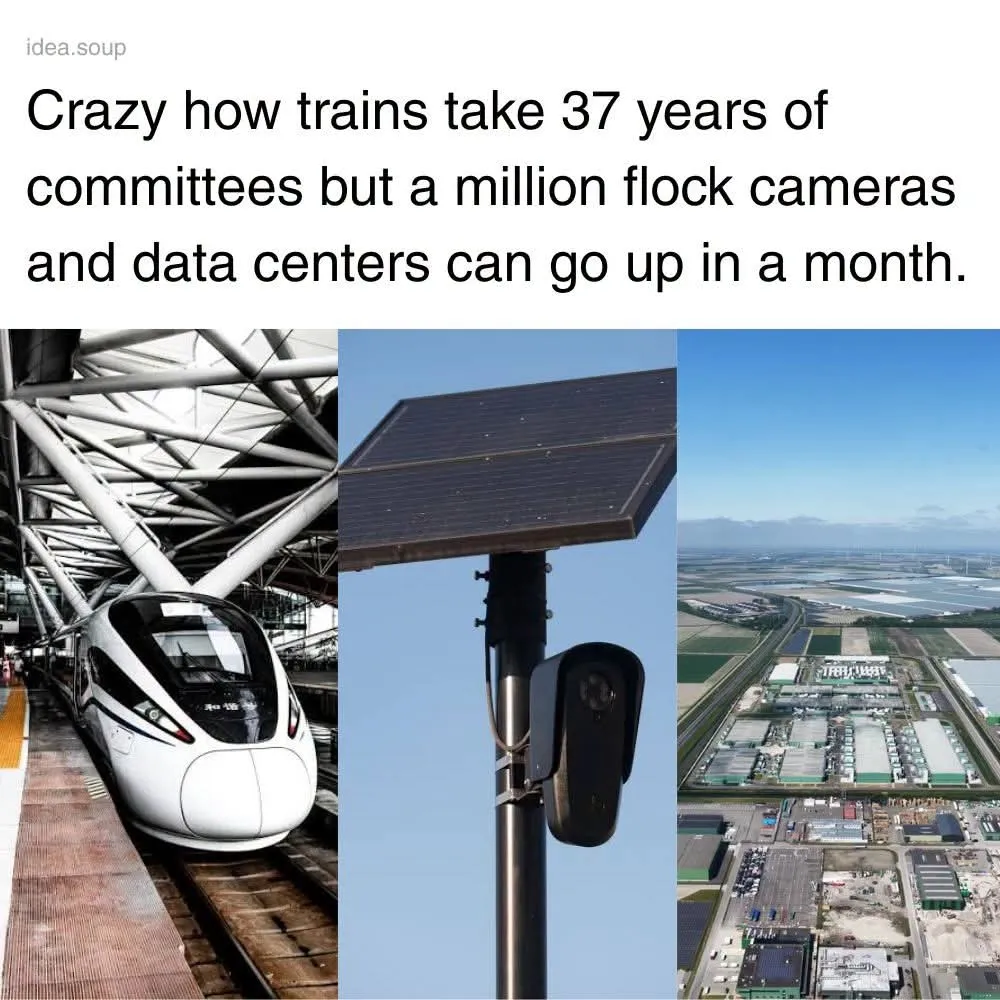
Everyone is talking about obtaining land and eminent domain and whatnot. …We have streets. 🤷
In America, yeah. Shit country!
So what would happen if I went to Home Depot and rented one of their trucks, added full accident coverage, and then immediately crashed into and knocked over, one of the lamp posts with the flock cameras on it?
A dropship would come flying overhead and combine soldiers would drop down and arrest you, if you’re lucky.
All of that is correct however I am also currently watching my government fail to be able to construct a train station along an existing track. So far the process has been going on for about six years and no one has so much has dug a hole yet. It’s barely even a construction project, they just need to pour some concrete into a rectangle and then add some stairs and call it a station. But apparently even that requires six years worth of committees.
Meanwhile in Scotland, somewhere with similarish land and planning laws. We’re electrifying the whole network, dualing large sections that were single track, removing peak fares, upgrading the rolling stock, and opening brand new stations.
Having a decent rail service is entirely a political choice. Whether those in power want to make it happen or not.
Flock cams don’t even need a power connection because they run on solar+battery, and wireless data connection. You can put one practically everywhere without any preparation - even the post it sits on is pretty optional, could use cable binders to hang them on a tree.
Data centers often get built where land is cheap, and at least in the US there is a (horrifying and stupid) trend to design them to run off-grid with gas turbines, so you don’t even need utilities there, just data connections that you can run underground.
Trains take up a lot of space, and if you want them to be useful, they need to be where the population density is high enough. That means high cost for land, often buying up big amounts of smaller lots where you have to work something out with a multitude of land owners who might not want to part with their - often prime location, because it’s in the city - land. A single land owner not selling their land can grind a project like this to a halt, at least if there is hesitancy using eminent domain, which is a crowbar approach and leads to resistance to your project.
Don’t get me wrong, i really think the USA would benefit greatly from modernizing and expanding their rail network! But realistically, refitting a train line into a city center where you preferably want the station to be is a hard task, doubly hard if you want to actually pass through the city because its not the head end of the line - it doubles the land acquisition woes. A possibility would be going underground, but underground construction is an expensive endeavor, and the US would probably need to get outside expertise from Switzerland or Austria where we construct tunnels through mountains and below cities on the regular to make it work.
The US famously bulldozes whole districts for their stupid highways, to build a whole highway junction inside cities (or whatever is left inbetween highway and parking lot).
Sure both train tracks and highways are harder than flock cameras or data centers, but the US certainly has no issue with building highways. All the issues are home-made. We have the same fucking issues here in Germany, it just so happened that more of our rail network (relative to size & population) survived the neolibertarian onslaught of the past ~60 years.
At the end of the day train networks primarily serve people, not capital.
Trains take up a lot of space, and if you want them to be useful, they need to be where the population density is high enough. That means high cost for land, often buying up big amounts of smaller lots where you have to work something out with a multitude of land owners who might not want to part with their - often prime location, because it’s in the city - land. A single land owner not selling their land can grind a project like this to a halt, at least if there is hesitancy using eminent domain, which is a crowbar approach and leads to resistance to your project.
There’s also interference risks. My city was building out their train network, and had to do extensive testing to make sure that the trains didn’t disturb the university’s experiments. An entire planned hospital was scrapped because it was too close to the tracks, and the trains would interfere with the hospital equipment.
A data centre or cameras wouldn’t have the same risk, so wouldn’t need to go through the same level of approval/testing.
Trains benefit people, those other things benefit billionaires.
And billionaires only care about one thing.
Control.
The future of humanity!
Where humanity is defined as billionaires, everybody else are just NPC.
California high speed rail was something my parents voted on when I was a child.
I had this friend who was a year under me in school. Her kid voted for it too.
It still doesn’t exist. California can’t build something as modern and cutting edge as a train.
If California became it’s own country and stopped funding the red States it could find the funding to build anything really
Real trains are cutting edge though. But yeah the usa just cannot.
We can’t manage a steam engine.
no you were really good at those! it’s just that you should probably have continued after that.
Indeed, the PRR S1, and the UP BigBoy are purely American, and the first is the fastest steam engine ever, and the second is probably the engine that can handle the heaviest loads with the steepest grades, without a chain. Though there are some honorable mention locos in Madison, IN that have the world record for steepest grade without a chain, but those guys can’t haul what BigBoy can. BigBoy can’t make that particular grade, not because it is too steep, but because the rails are too narrow and curvy. Deisels can’t compete for load weights, neither can electric engines. Un/fortunately both diesel and electric beat the crap out of steam on maintenance costs and downtime.
Fucking shame about Roger Rabbit.
We were, we aren’t.
If you want to build a train in empty space I’m sure you could get that approved pretty quickly. Of course, it’d be useless. The biggest problem with trains is getting land for it since they are most useful where there’s a lot of people.
I hate these data centers and flock cameras as much as the next guy, but they aren’t really comparable. Flock cameras don’t even take up much space and they are put up on land the government already has. It’s like asking why it’s so easy to put stop lights.
Sorry, I’m Mr Buzzkill.
The USA has no problem bulldozing housing to build highways.
Yeah, but only because that land belonged to blacks and cut prospering communities in half to drown them in traffic hell. You wouldn’t want a repeat of that.
Rip out the extra lanes of the damn roads and highways that induced demand, and we got all the space we need without destroying much in the way of existing buildings. A double track is only about as wide as one lane of our surface stroads.
This. American roads are widened constantly for no reason other than paycheck justification. They could rip out existing highways (which cause lots of traffic) and replace them with trainlines.
One direction of high speed rail track would require at just under two freeway lanes worth of width (two directions need ~4 lanes).
And that’s before dealing with the additional freeway/rail safety separation, barriers, shoulders, drainage, etc.
While there are sections of highway that could support this amount of removal, if definitely not as easy as “swap road for track, done.”
I don’t see much of an issue since we already have 8 lane interstates connecting the vast majority of the cities in this country. The HSR could even connect with the light rail using existing bypasses. We have already emminent domained more space than we need, both inside and outside of the cities.
Easy? No. Easier than continuing to support a broken system of highways that hasn’t been revisited in policy since at least the 1970’s? Yes.
The double track I was referring to is the light rail that one would use in urban areas. HSR has no need to expand all the way into most city centers.
In the ideal situation where there are 8 lanes sustained throughout the entire proposed path, that still means removing at least 50% of the current inter city infrastructure. While adding more lanes is always a temporary fix, removing that substantial an amount is simply not feasible and the reason it hasn’t happened yet.
And yet it is possible and feasible in every other country, including ones like The Netherlands that followed us down our idiotic path, until the early 2000’s, and ripped out the roads and gave the cities back to all forms of transportation.
It isn’t possible because no one is willing to do it, other than some of the coastal cities on the west Coast, where it is slow, but works damn well.
None of this is written in stone. Critical infrastructure should always be prioritized. We see how China did it. In the end it’s all about political will.
We all know that China prioritizes critical infrastructure like flocks of cameras and the associated data centres to closely monitor its population. Hence they are built quickly, whereas trains take way longer then a month to be set up.
Somehow ut still works in pretty much every other country
Yeah, this is cheap ragebait. Most of the stuff online is optimised for that outcome so I end up rolling my eyes most of the time.
I am all for calling out privacy-invading cameras but comparing the putting up of small wireless cameras on already existing poles with prepping existing rails for high speed train connections, not to speak of actually buying the trains and maintaining them properly, like what? The cameras have no risks of causing accidents either, aside from people accidentally cutting them down (as one does). So the comparison feels pretty silly to me.
Now compare it to something like building another 3 lanes on a highway, thats more appropriate.
Just one more lane and traffic will be gone. Trust me on this.
Just put the datacentres on trains
“Sloppiercer”
@grok plz generate this movie, no woke
??? Flock seems shitty (I’m Canadian) but it seems like a lightpole or so. A train and the network requires a million times the property appropriation. And to be effective, a chunk of that should be the most sense/expensive land around!
Hmm let’s have a think about how much each system costs, what the consequences could be if implemented poorly, and how much they involving depriving people of what they currently have?
I mean Flock cameras, if implemented poorly (or successfully) involve depriving people of their privacy and their consequences include aiding aspiring tyrants in violating people’s rights.
Oh yes, that aspect is a deliberate part of the comparison. I don’t know about you though, but I’d rather have a flock camera outside my house streaming my every move directly into the secret service’s masturbatorium than have no house at all, or to have a high speed railway 100m away from my house, depriving me of the peace and quiet I used to enjoy.
(So, in my country the government has to pay me the fair market value of my house, plus an additional percentage, to compel me to sell them my house when I don’t want to, so the former scenario may not work out as a “deprivation” but instead come under the “cost” category - but it’s a cost because the alternative is seriously depriving people of much more than their privacy)
Are there any new datacenters really being built, I have seen several infos that they mostly are “planned” (they order all the pcs & ram etc) but the building itself is often not even started? Especially the power requirements are not factored in, it takes a handful of years to build a power generating central the size needed?
I feel it’s “let’s burn everything to the ground” in a last-ditch effort to prop the AI bubble afloat another month or 3.
They are abandonding more and more planned data centers, but there are still lots of them being build and new ones being planned as well.