You must log in or # to comment.
deleted by creator

deleted by creator
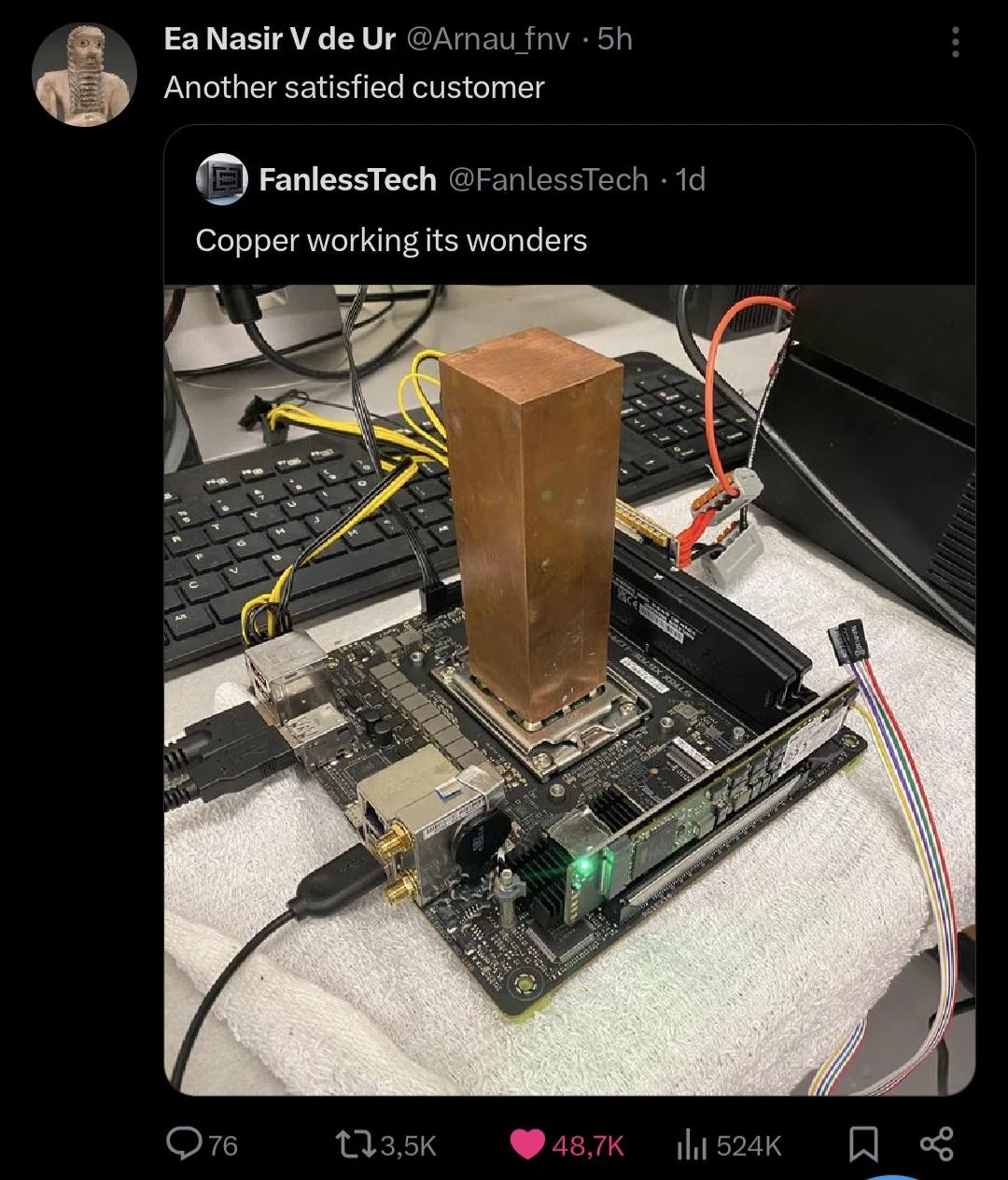
Till it all gets to temp then it won’t do much. It needs some more surface area to convect heat better.
With enough fins you don’t need fans.

the other option is

only fans
Would a slow small fan still make a huge difference to the cooling here? Completely passive cooling seems like something that would only make sense in very specific professional environments (like needing an ultra low sound floor in an audiology chamber or recording studio).
I had a roommate who was getting his doctorate in chemical engineering, specifically focused on graphene. He was able to demonstrate how doping the materials in a heat sink to alter their ability to “release” heat, and then organizing these intentional hotspots along the length of the fins, you could create an active airflow using a stationary object.
But then his lab manager killed his grant and instead put him on a project partnered with BMW to make their bumpers more marketable.
Really makes you wonder how many revolutionary ideas have fallen through the cracks because of moron management
Black pilled by monetary interests.
Many folks in higher education in the UK have been bemoaning a generation of genii lost to business and the City who put their talents and creativity to the good of making profit rather than inventing and humanity.
Many more have their funding and direction tilted to capital, too.
If you’re a Mathematical prodigy you either become a Quant making mathematical models for Price and Risk of Over The Counter (so, not sold in a Market) derivatives or, if you have good salesmanship skills, a Trader of such financial instruments.
None of this brings any actual improvement to Mankind but it sure pays well (more the latter than the former) since the way our Economic System is structured and as a side-effect of unbalancing the playing field to make sure the wealthy get ever more wealthy, Money is the thing that makes the most Money, and even just a tiny slice of such flows is far more monetarilly rewarding than almost all other forms of creation or discovery.
That’s a shame that sounded really cool.
Who knows how many great ideas we have lost because of bad management and capitalism…sigh
The case has an opening for a vertical fan but it is not needed unless you do heavy gaming and run a high end GPU. For video rendering and other tasks the fins are rated to keep it at a decent temp.
I have good hearing, and a HDD spinning or even a “silent” fan is still audible droning noise to me.
This build is totally silent. The PSU is over-rated on purpose because it has a below 30% max draw mode that is fanless.
So this case makes 0 noise.
With big enough copper block it might not matter (like the size of a house, but of the good quality stuff not that shit Ea-Nasir sells).
what is that white box on the bottom connected to
The empty copper block is for a GPU, but I’m running this primarily as a silent server so I didn’t bother with the GPU since it has integrated Graphics.
I think that would be a spot to connect a GPU to the heatsink as well
Passive cooling fins.
Is your motherboard connected to two giant case-sized heatsinks? I’m struggling to see the big picture here
Oops, all heatsink
Its a monsterlabo case, they made fanless heatsink systems…I think they may have gone out of business a few years back because a silent case is very niche.
https://www.vortez.net/news_story/monsterlabo_the_first_chassis_now_available.html
Right? I’m like wtf is this setup?
It’s a monsterlabo case. They used to make a few models that were all heatsink so you didn’t need fans. I think they might have gone out of business because their website has no stock left for ordering, etc. Too niche a product to sustain sales probably.
Edit. No website anymore either.
But here’s the case I have. https://www.vortez.net/news_story/monsterlabo_the_first_chassis_now_available.html
Okay, who gets to be the lucky one to calculate the amount of time that thing could heat sink a pegged, modern, 120w TDP CPU before it throttles at 100C? I’ll give you a sticker.
Let’s assume the dimensions of the copper block are 40mm40mm160mm (I’m not taking the heat spreader into account here)
That results in a volume of 256000mm3, or 256cm3
Copper (at 20C) has a density of 8.935 g/cm3, so that’s roughly 2.28736kg of copper
Copper has a specific heat capacity of 384.603 J/(kg K)
Using E=cm∆t, we can figure out that it would take ≈ 70378J of energy to heat the copper block to 100C, starting at 20C
With a TDP od 120W, that means it would take 586 seconds to heat the block to 100C, or 9m46s
This is probably way off but I was bored
Your napkin math is the best we have. We will make all decisions based on it.
They will have entire hard drives explaining KSP Atlas’s shitty math in 3 thousand years…
Hmm, I think at minimum calculus will need to be involved here. Because we can’t just assume that the heat is spread evenly in the copper - it’ll likely be hotter at the bottom, leading to thermal throttling earlier than expected. On the other hand, there’s going to be heat dissipation into the air, which will help cool the block somewhat
Edit: made a program to model heat transfer and heat loss. It seems to only affect final time by a handful of seconds. So actual time in real life is probably somewhere in the ballpark of 10 minutes
The conduction in copper is fast enough that there’s not much of a difference between the top and bottom.
Copper conductivity is fast, sure, but it’s not fast enough to have equal temperatures at the top and bottom for such a big chunk of copper. That does affect the time to thermal throttle pretty significantly, actually. If we assume completely homogeneous temperatures across the block (ie, instantaneous heat transfer), according to my model, it’ll take 703 seconds to thermal throttle. With heat transfer, the time drops to 592 seconds - a difference of about 2 minutes
Heat transfer will not limit much, but heat loss should add a significant amount of time. How did you model that?
I left another comment going into more detail about the model specifications, if you’d like to read into it. But briefly: I took the copper heat conductivity coefficient and the air heat transfer coefficient. I sliced the copper block into thin slices and modeled heat transfer between each slice, as well as heat transfer between each slice and the surrounding air.
It seems that both heat transfer and heat loss do actually matter quite significantly, but they just cancel each other out almost entirely.
If we assume instantaneous heat transfer, thermal throttling time goes up from 592 seconds to 703 seconds (about 2 minute difference).
If we assume no heat loss to the air, thermal throttling time goes down from 592 seconds to 500 seconds (about 1.5 minute difference).
If they cancel out, the system would be in balance and not get hotter. So some thing does not add up. What heat transfer coefficient did you use and which other numbers etc.?
No, the heat propagation through the copper block (meaning the contact surface gets to 100 degrees before the top of the block) balances out that the copper block loses heat to the surrounding area via it’s side walls.
deleted by creator
Account for convective loses into air?
Its going to radiate a little bit too.
deleted by creator
This doesn’t seem to account for convection, which is presumably the entire point of a heat sink?
Was intrigued, so made a simulation to figure it out.
TLDR: 592.2 seconds, or 9 minutes and 52.2 seconds. Very similar to the other comment - it appears temperature differentials and heat loss to the air have opposite effects on thermal throttle time and mostly cancel themselves out. For the most part, heat transfer and heat loss appear to affect the thermal throttle time less than the sheer heat mass of the block by several multiples
Assumptions:
- Copper’s heat conductivity is 400 W/m-K, and specific heat is 0.4 J/g-K, and density is 9000 kg/m^3, and these values do not change over the range of temperatures
- Air’s heat transfer coefficient is 20 W/m^2-K and does not change over the range of temperatures
- The surrounding air does not change in temperature and remains at room temperature (25 C)
- The input wattage is actually 120 W and not just random marketing bullshit
- The copper block’s size is 4 cm x 4 cm x 16 cm (same as other comment)
- The temperature within the copper block differs only by the vertical axis; it is assumed that temperature does not change if you move horizontally into the block
Modeling conditions:
- The block is sliced into 100 equally-sized slices, stacked vertically.
- Each slice starts off with a temperature of 25 C
- 120 W is input directly into the bottom slice
- Heat transfer is modeled between each slice
- Heat loss into the air is modeled for each slice (top slice has more heat loss due to more contact with the air)
- Temperature changes are calculated per millisecond
- Final time is calculated by the total number of milliseconds it takes for the bottom slice to reach a temperature greater than 100 C
Fun facts I found from playing around with the model:
- According to this model, at the time that the CPU thermal throttles, the top of the block should be 85 C
- If we assume instantaneous heat transfer, time to thermal throttle goes up to 703 seconds (11 minutes and 43 seconds). Difference is about 2 minutes.
- If we assume no heat loss to the air, time to thermal throttle goes down to 500.0 seconds (8 minutes and 20 seconds). Difference is about 1.5 minutes.
- The copper block should be able to prevent throttling as long as the CPU remains idle (30W for AMD CPU’s). The CPU should cap out at around 82-83 C.
- The copper block can prevent thermal throttling for a 170 W CPU for 368.1 seconds, or 6 minutes and 8.1 seconds
Well goddamn… Ok. Go ahead and dm me your home address, phone number, social and/or tax id number, the name of the street you grew up on, the name of your favorite teacher, the IMEI number of your cellphone, a high resolution set of your fingerprints, and a list of your three greatest fears, and I’ll get your sticker sent over as soon as I can.
Respect for taking the time to model that. Goes to show why heat sinks look the way they do, and not just big lumps of metal lol
Numerical methods is cheating! Real men use PDE’s!
/s of course, though I was kinda hoping you’d use PDE’s
See, I thought about doing that, but then I realized: I don’t actually want to do that
What software did you use to model this, btw?
Python
You did the monster math.
Respect.
Did the model include some air movement by way of the fans on the case. That would be a fun thing to think about.
The fact that the air remains a constant temperature means the model is assuming infinite airflow.
It didn’t model convection at all.
How long a copper block do I need to prevent any throttle?
Good question. I had to modify my code to run more efficiently, since not throttling implies that the copper block reaches a steady state with very little temperature changes over time.
But, with the changes, I can say that there is no copper block length that would prevent throttling with a 120 W CPU. It seems the heat transfer within the block is slow enough over such long lengths that you get diminishing returns with longer and longer copper blocks. Here’s a graph I made summarizing the different block lengths that I tested

With a 65 W CPU, a 32 cm (double the original length) copper block is sufficient to prevent throttling, but it’ll reach steady state at 97 C
Have you considered the possibility that Ea-nāṣir might have been delivering inferior quality copper to you?
Ea-nasir promised that these were good quality copper, and I do not have any reason to suspect otherwise. But I’ll have you know, if the copper is of inferior quality, I will make sure to send my messenger to complain. He will not hear the end of it!
Would the result change if the copper block gets wider instead of higher?
Apparently, yes. You can prevent thermal throttling if you expanded the base from 4 cm x 4 cm to 4.5 cm x 4.5 cm, and if you increased the height from 16 cm to 100 cm. The temperature caps at around 97 C.
Nice try. I’m not googling “copper pegging” again.
That thing doesn’t make any sound so you gotta search “Copper Sounding” instead.
I hate that I know what that entails.
If you want to do it, but don’t have a proper sounding rod, you can just use your house key instead.
What if I keep blowing really hard on it?
Toblerone Gaming Heat Sink.
Toblerone has one identifier, its triangular shape. ☝️🤓
But there is another… the convection space between the fins.

I remember when that space was less… Spacious.
yeah that looks so weird right?
Toblerone has famously been shrinkflating their product for some time.
I remember seeing a comparison post many years ago of a modern one vs one that had been bought years ago and rediscovered in a closet or drawer or something. The older ones had thicker spikes.
I wanted to check the visual difference and found that it is the top picture in the shrinkflation Wikipedia page haha. https://en.wikipedia.org/wiki/Shrinkflation
A bar of disappoitment
A block of diamond would be even better (copper being at 401 W/mK, Diamond at 3320 W/(mK), almost 10x better)
But only 3-5 diamonds are generated per chunk, requires an iron pickaxe, and usually doesn’t start appearing regularly until Y level 14.
Meanwhile copper can have up to 16 veins of copper per chunk, requires a stone pickaxe, and appears most frequently at Y=48.
Copper is clearly more accessible for making ore blocks.
Wait a sec, this isn’t !minecraft@lemmy.world
Back to the mines with you, you’re yearning
This is after 1.18, Diamonds are most commonly found at Y=-54 now.
with the way prices are going, carbon based heat dissipation may become the preferred option
how pretty would it be if it was a tree-like crystal structure
What’s the K
Gonna assume kelvin
Think C but what if zero was actualy zero
Watts per milliKelvin? I wouldn’t think that would be a form of thermal capacity OR thermal dissipation, which is why I asked
Edit:
Looked it up…
Apparently it’s “watt per meter-kelvin”, a/(the?) measurement of thermal conductivity.
Per Wikipedia ( https://en.wikipedia.org/wiki/Thermal_conductivity_and_resistivity ):
The thermal conductivity of a material is a measure of its ability to conduct heat. It is commonly denoted by k {\displaystyle k}, λ {\displaystyle \lambda }, or κ {\displaystyle \kappa } and, in SI units, is measured in W·m−1·K−1. It quantifies the proportionality between the heat flux (heat flow rate per unit area, W·m−2) and the temperature gradient (K·m−1) in the direction of heat transport.[1] The reciprocal of thermal conductivity is called thermal resistivity.
Materials with high thermal conductivity transfer heat more efficiently than those with low thermal conductivity. Heat transport can arise from different microscopic mechanisms: In metals, thermal conductivity is typically dominated by free electrons, whereas in dielectric materials such as diamond it is largely due to lattice vibrations. Materials with high thermal conductivity are used in heat sink applications, while materials with low thermal conductivity, such as mineral wool or Styrofoam, are used for thermal insulation.
Ketamine
Kooling, obviously
Silver would be more feasible though. It’s next best after diamond.
It has higher conduction but it’s specific heat capacity is worse, at least per mol
Customer
But is it really copper?
Ask Ea-Nasir.
Lets hope CCA doesnt strike again
This is a beautiful connection between science about the past and science about the present.
I give it 9/11. It can use another tower.
NO that swindler gave me subpar copper!
I don’t believe you. You probably didn’t even write a support ticket about it
You didn’t pay him for a previous services. Ya get what ya pay for.
Copper? I don’t even know 'er!
Too efficient. Needs to be spherical.
Also, levitating via magnets, for some reason.
Yeah man, I dunno what that whiny bitch Nanni was on, but this some good quality copper.
so how many grams is that?
I am suddenly reminded of that Tech Ingredients video on YouTube where he turned a A/C window unit into a liquid heat pump.
Without fins the cooling won’t last long, and when the bar heats up fully the CPU will throttle or burn up.